Christmas card

Bubble thoughts

I don’t have any Important Thoughts screaming to crawl out of my fingers today. Really, what is occupying most of my thoughtmosphere is Christmas break—one week, baby! One week until I can push the planning and worrying and kids into a box and tuck that into the closet for just a little while. Between now and then I need to coordinate the 7th grade Christmas presentation, find a present for Joe, my Secret Friend, make an extra-credit-for-failing-students-because-it’s-illegal-for-students-to-fail homework packet, and avoid putting everyone in permanent time out.

Here is, in listicle fashion, what’s been knocking around in my head this week:

1. Jellyfish. I feel helpless when I suspect my students are making fun of another student in Spanish, but I’m uncertain and don’t know what to do. It turns out that after I drew a jellyfish on the board that some of the kids compared that unfavorably to another’s head.

2. Bananas. On grade day, when students are absent and parents visit teachers to pick up report cards, I commented to the school cook how much I was enjoying the quiet. This prompted a bevy of “Children are the lights of our heart”-type responses from the cook and two mothers who were helping. I left the kitchen that day embarrassed and convinced that I was now on the cook’s bad side. I’m glad to report I was wrong: she cooked me, and no one else, a sweet banana on Friday.

3. Fridays. Fridays are the worst days for the 7th graders and me. While we have only two classes together that day, I’m so burnt out and they’re so squirrelly that we almost always end the week on a bad note.

4. Dichotomy. I am unable to reconcile my frustrations with a student who disrespects me during class enough to ride the busito home with her to tutor her sister for free. While I enjoy the tutoring, it is awkward for me to have casual, occasionally confessional on on my 7th grader’s part, conversation when I was so annoyed with her only two hours earlier. But, I’m also just really tired. She’s a good student who has more life stress than a girl her age should have. I tabled the tutoring until after the break.

5. Song. How the heck do I teach a song that I can’t even sing?

6. Goof. Two of my 9th graders asked me if I am a serious or silly teacher. They said I am silly. I said I am serious with a touch of goof. This was a goofy-teacher week, no doubt fueled by break anticipation, that involved a lot of arm bending and waving (animal undulation and oscillation), hand fins on my head, sides, and butt (more oscillation), and cruising sllloooooooowwwly across the class to demonstrate that while turtles may be slow, they do locomote.

7. Oatmeal. I must not finish all the maple brown sugar oatmeal (gluten-free, care package gift) this weekend. Helloooo, sweet tooth.

8. Gifts. What do you buy a 13-year-old Honduran boy?

9. Holiday. Over break I plan to travel to La Ceiba—the party town of Honduras, but I’m going for the nature—and may be lucky enough to stay in someone’s apartment, if her current tenant is still out of town [update: the tenant is coming back into town; other plans in the works]. Also, it’s expensive traveling solo but not wanting, because I already live in a house with five other people, to stay in a dorm on my vacation, because I have to pay for two people.

10. Borax. So many cool Christmas science projects involve Borax. There is no Borax here.

11. Grrr. “It’s all in your head.”—roommate to me.

12. Water. Sometimes the morning shower is a little too cold.

13. Teaching. At about 26 classes a week, I have the heaviest teaching load. Is this a normal load? Do I do a normal amount of planning? If so, I don’t think this life is for me. Then again, the school did just give me two textbooks that appear to follow the science curriculum. If they find a biology text, I just may have cut my planning time significantly.

14. Students. I really like some of my students.

15. Bubble. I rarely peek outside the microcosm that is my teaching life in this small town. While I see the headlines and occasionally read articles, I don’t have strong emotions toward any of them, like Ferguson or face-sit ins. I get the gist and move on. On reddit I’m more likely to look at cat pics. Is this good, to so willfully disconnect from all the rest of it? I am not a good citizen of humanity.

16. Feet. After school my feet are really stinky.

Undoubtedly,

theresa

Kids and me dancing

Level up

I just don’t think quickly. My high school biology teacher said he liked to watch my face during class because he could see me putting the pieces together. Sometimes I do feel like my thoughts are a Tetris game, somewhere around level 4, when the pieces are falling a wee bit faster than the initial level. An idea drops down, I slide it into place, another idea drops, I flip-flip-flip it and slide it into place. Idea by idea, click by click, until things are lined up and…release: I understand.

Early this week a final piece fell into place, and I leveled up after verbally chastising a student again for an action that deserved at least a name on the board, lost my train of thought, as I do during these moments, and turned to wipe the whiteboard, while the gossip behind me quickly rose. I am a teacher, regardless of the green around my ears, and I deserve attention and respect. Why am I not demanding it from my students? Why am I not teaching them what I need and deserve? Why am I disrespecting myself? If I don’t demand it, if I don’t teach them how to practice it, if I don’t show it to myself, how can I expect my students, children who laugh when someone hurts him/herself, leave books on the floor, and have no trouble telling me their peers are stupid, to give me respect? I can’t. Having read my teaching posts, I would expect loyal readers, or actually anyone, to be thinking, Took you long enough. 

The parents I’ve interacted with give me respect without my having to ask for it or prove myself. I was invited to a birthday party for one of my 8th grade students. The mother seated me and my three fellow volunteers at the table on the best chairs. The mother, aware of my passion for fried sweet plantains, made a special plate of them for me (which I reluctantly shared). When we parted she told me, “Nuestra casa es su casa.” Other parents and two of our Honduran teachers have said the same, and while the phrase is almost cliché, part of the travel-outside-of-the-US-everyone-is-so-kind lore, the faces the words come from appear genuine (and, goodness, I sure would love to visit these houses more often if it weren’t so damn awkward for this monolingual wallflower). If these parents can give me, a neophyte teacher, such respect, even kindness, again, how can I not give it to myself? Level up.

‘Cuz this shit’s for real. I may be green but I am one of the many tools that will help mold these little human beings into adults, and I’m no less important than any other. Rationally, I know this is true, but within the emotionally charged spaces of my mind, in the gaps between my bones, I feel so small, like a wisp of a person who’s barely there at all, or bothersome, like that person who is blocking the [insert tasty food stuff here] you want, and my personhood, the fact of my existence, is much less important than yours. Reader, whomever you are, I will usually assume that despite my having grabbed the last jar of [insert tasty food stuff here] first, you deserve it, somehow, because your presence is much more solid than mine, your immediacy is felt, your wants are known. Much of the time, that is my reaction. Though not always. Sometimes I will take that damn [insert tasty food stuff here] because why the hell shouldn’t I? I need more of those days.

I ponder the origin of this conflict and some of it I know, some will remain a mystery, part of my chemistry reacting to the world, but ultimately the origin is unimportant. I am here and now.

Now, where does this all leave me? Still wiping the whiteboard, burdened with new understanding, uncertain of strategy. The blocks fall faster now and I’m not flip-flip-sliding fast enough. A fellow teacher said I must like the battleground that can be my class, otherwise, why wouldn’t I change it? Well, I’m only an inch tall today.

Back to class. Friday afternoon was playtime since it was the first event of the school Olympics*. The Olympics ended early, leaving me with 8th period to fill with practicing our song for the school Christmas celebration, and then the last 10 minutes free after the kids give me 3 past continuous sentences. I admit my attention is elsewhere, then I turn to see one of my girls climbing the forbidden stairs, forbidden because they lead to the roof and each step is just a metal frame, with no center. And what was it about that moment? Was it the uncertainty I was feeling over how to teach the student-chosen song and my kids’ growing frustration with it? Was it the post-performance crash after the rush of my Olympic team being the highlight of the presentations? The girl, and her cohort, managed to push the Activate Teacher Yelling Voice button, which did draw them back to the group but didn’t stop their giggling through incomplete apologies. Then I felt ashamed. Another teacher, who witnessed the event, felt my response was just right, but…I don’t know. This isn’t the way I want to do these things, but I have put the pieces in place that lead to that moment, despite my knowing I should do otherwise.

It’s two weeks until Christmas break and I doubt I’ll do much changing until then. For now I’m hanging on, trying to balance teaching with the fun of holiday classroom activities (Secret Friend, decorating, blah blah). But after Christmas break, a time I’ve read and heard that newbie teachers return to school invigorated and with new plans in place, I have to empower myself for change.

*So what are the school Olympics? The students are divided into houses (Yellow, with Vee) and the houses pick a country (Italy) and the first event is presentation of the country to the school. The event du jour was unanimously mine, a simplified Tarantella with the 1st, 2nd, and 3rd graders, a simply sweeter than sugar group of kids. Throughout the year are other events, such as the sports competitions this upcoming Friday. Kids can earn additional points for their team by being awesome in class (I am terrible at awarding these points.).

In other news, almost all of my students passed their recent Science quizzes—a first—and many of my 7th graders are now able to put together a past continuous sentence, but despite my best efforts and use of science, my more religious 9th graders refuse to believe that humans are animals.

And that’s that,

theresa

the road

The Roads

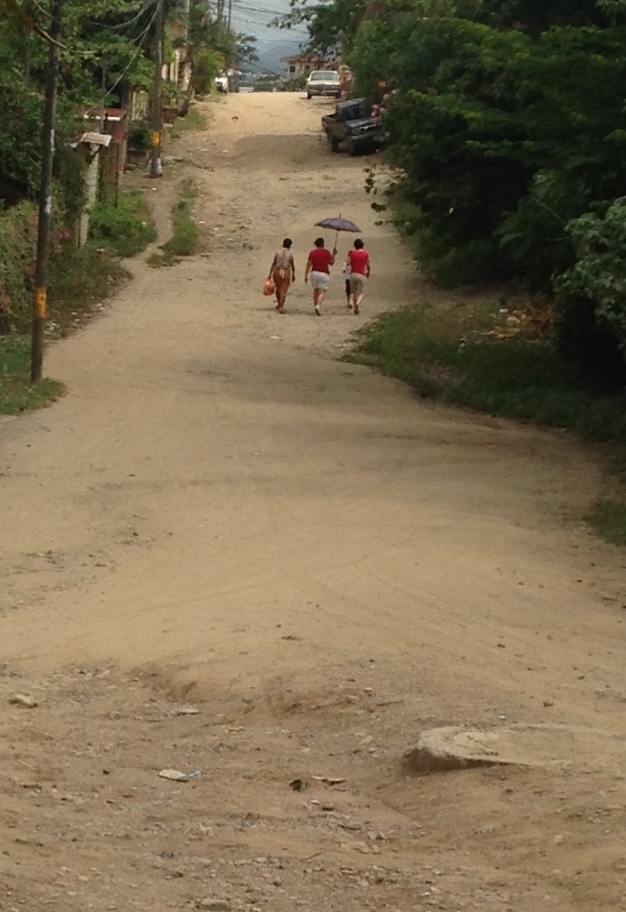
This town is designed for walking. Within the length of a city block from my house are four pulperias. They sell everything from toilet paper to packaged cookies to produce to used clothes. Within a one mile radius are scads more pulperias and hardware stores, used clothing stores, produce stands, bakeries, and stalls that sell tacos and baleadas, underwear, watches, and fans, pharmacies, restaurants, cafes, clinics, churches, and two supermarkets. New stands appear every day. The only parking lot is that of the new supermarket, and while the store is crowded inside, the lot is mostly empty.

Until I reach the commercial area with its two paved parallel streets, I can walk anywhere in the road with little fear of being squashed by cars. At times this is required because a portion of the dirt and rock road is filled with a large puddle or is too rocky or uneven. The road isn’t much wider than a car, so there really isn’t any side to keep to. The street can be noisy, but it’s usually the noise of conversation, music, kids yelling, and roosters proclaiming some edict or other. Nothing rushes by faster than I could run, except a mountain bike braving the downward rocky slope. Cars that do pass barely crawl above 5 mph because the road is so uneven.

Everything is snug and huddled close. The houses are within speaking distance. The tallest building has two stories.

For while I’ve been gnawing on why I don’t mind walking to the supermarket everyday but would groan at the thought of doing that back in Portland, where the distance between house and grocery is comparable. I live in a “walkable” neighborhood, which in the US means there are sidewalks on most of the streets and a grocery store within a mile of my house. But it’s noisy. I have to stand at stop signs to wait for car (and bike) traffic to pass. The road is much wider than speaking distance and the buildings tall. It’s neat, contained, and no doubt all regulated by some sort of rule. And while I could walk in the middle of many of the side streets, I haven’t the desire since it all is black asphalt, without the proximity of trees, houses, any sort of character. After all, they are often wide enough to fit two cars, with more cars parked along the side of the road. I’m a dwarfed speck amidst the hubbub of machines, the shadows of apartment buildings. People walk protected in a self-contained armor of haste, preoccupation, cell phone, and distance. Doors are very much closed and sit separate from the street. Walkability is relative.

Here, every window has bars and houses sit behind barriers of some sort, yet the door might be only a curtain, laundry hangs in the yard, people are in the doorway or at the gate or hanging that laundry. The doorway is open and someone is watching television. It’s open, and yes that can be annoying when that means having those eyes on me, but often if I look up the eyes won’t shy away. Maybe they’ll smile or not.

[I interrupted this entry to write: Am I really writing about walking? Maybe, again, I’m really writing about fitting in? I look at everything through the lens of my previous life; objectivity is non-existent, in the end.] 

I am also cloaked in a silence that comes with the language barrier. I don’t have to fear being spoken to by a familiar face, beyond a greeting, because s/he knows I won’t understand. Back home, I would cross the street, turn a corner to avoid an acquaintance if I wasn’t feeling capable of awkward small talk. Here, that acquaintance and I warmly—at least on my side—acknowledge each other’s existence and then move along, little risk of small talk.

I am in no way idealizing the roads, not that this is really a post about them, is it? The roads are covered in trash. During a heavy rain, the bottom of our road floods and unless I want to walk several additional blocks to circumvent the pond, the only passage is through and, depending on the length of the rain, the water and other muck may reach knee height. Navigating the holes and rocks makes for moderate ankle-twisting ambulation or head- and rib-knocking driving/riding. The roads have been “repaired” since I’ve been here, meaning that piles of dirt were spread to fill the holes. Gradually, the heavy rains are exposing the gaps and large rocks. On other roads, gravel is used to fill the same areas over and over. Some kids miss school on rainier days. Our class trip to San Pedro was cancelled due to mudslides. The highway, with its lack of lights and many holes, is teeth clenching at night as cars swerve across the obstacle course .

I assume that poverty prevents car ownership and that many people would prefer to have a car. Or would they? Moto-taxis go anywhere within town for ten lempiras (USD 0.50) and bus connections take a person just about anywhere in the country. I’ve seen women unloading tuk-tuks stuffed with plantain-laden branches and tuk-tuks transporting construction equipment, the length of the wood or metal bars three times that of the little three-wheeler. And there is nothing quite like riding in a shared vehicle. A van that claims to seat ten will easily fit twenty-five if you leave the sliding door open so that passengers can grip the roof and stand on the runners. One of my students balanced three other boys on his bike and rode them all to football practice. People make do quite well, as you do when you have to. When you don’t have to…everything and everyone separates, I imagine.

So what is this post really about? I’ve touched on cars, roads, walking, poverty, language barriers. Maybe it’s about the pleasures—to an introverted outsider—of a smaller (adjective chosen without the slightest condescension and with full awareness of how much could change with improved technology and infrastructure) world. Whenever I return to something that resembles my previous life, I have no doubt I will miss the community and quiet and coziness of a walk down the road.

Ta ta,

theresa

P.S. This may be the only time I say that the town is quiet. In most other ways, it is anything but.

Smiling

Thank you for smiling

I never knew just how much I rely on smiling in business exchanges. It happens less now, but I when I purchase something from the secret pulperia (a pulperia semi-hidden behind a wall) and the owner doesn’t smile, I wonder if I insulted her, was rude, or if my purchases were annoying. When she does smile, I walk down her steps content, even if she’s out of the tortillas or tajadas I requested. This type of interaction repeats everywhere: the produce stands, the school supply store, and the supermercado where the clerks tend to look rather bored, though that’s probably just their resting faces. The clerks and owners are polite, but there’s no smile to accompany their Buenas/Hola or Gracias and, despite repeated exposure, I replay the interaction, looking for my offense, searching for the smile.

Resting face

My neutral face looks a little sad.

Articles, discussion threads, and studies about cultural differences often cite the “friendliness” or “politeness” or “smileyness” of the U.S. population (just google “culture” + “smiling”). Depending on the author, this is either praised as welcoming or disparaged as sign of the culture’s falsity. In my previous life, when I read these articles I would think of frozen-faced flight attendants as they waved me off the plane or the grumpy check-out person who definitely did not smile while helping me, the supposed British stiff upper lip or the rumor that Germans have no sense of humor … but I wouldn’t really understand what the author was talking about. People in the U.S. smile too much? Yes, some are bad at faking it, but what does “too much” mean? After all, I come from the land of smile therapy.

Now I think I understand, at least a little. As much as the disinterested facial expression causes the furrow between my brows to deepen into a canyon, why is it reasonable to expect a smile during our business transaction? I need something, s/he supplies it. Why does s/he need to appear thankful, and why do I either when it comes down to it? Does this transaction give either one of us significant pleasure? In the day-to-day, probably not. It’s about supply and demand. Let’s keep it honest and not muddle it with emotions. I find working in customer service, particularly in a store, face-to-face with customers, exhausting. I have to fake enthusiasm for a stranger and her/his purchases for 8 hours. Really, while I wish the customer no ill will, I rarely could care less. I’m there because I need money and the customer is there because s/he needs what I happen to be selling. I and the store I’m in are no more than a convenience. Yes, I’m happy to have a job and I will serve you with the courtesy you deserve as a human being, but why am I required to make it personal? Does it have something to do with the U.S. prioritizing industry and money over humanity? I’m sure there is a profit margin attached to a smile, or what appears as a smile, because a genuine smile can’t be imitated. (Accept no imitations, folks!)

Smiley face.

I don’t really smile like this, but I look happy.

Despite my burgeoning awareness, I continue to seek out the smile. I frequent the same licuado stand because the young man always smiles during our exchanges. I doubt our secret pulperia has better prices than my usual produce stand, but the young girl who occasionally helps me can be so goofy, thus I buy bananas. In the States, I will return to a store if the clerks smile, even if the prices are slightly higher. That’s my reaction to an upturn of lips or baring of teeth, but what is the reaction of someone used to a less smiley culture? A culture that doesn’t equate smiling with competency and courtesy? (There have been reams written on this topic and my question doesn’t merit notice, so I’d rather ponder and navel gaze than research at the moment.) Conversely, I am slightly more comfortable with not accompanying my Gracias with a smile if I’m not feelin’ it. I’m less afraid that I will be found rude.

Besides, smiling causes wrinkles, and who wants that? Hmm…maybe cultures that smile less are secretly obsessed with appearing youthful. No, that’s the U.S. Never mind.

(No, I really don’t care about wrinkles. Well, not much, yet.)

Shake your ta-tas,

theresa

P.S. Having a mouth close up at the top of this post may not be the best decision.

P.P.S. Feeling a little bit of the goof today, in case you couldn’t tell. And while we’re on the topic of goof and smiling, Miranda rarely fails to evoke my genuine smile.

Hunger

In the States I was always hungry for what I didn’t have, for who I wasn’t.

In Portland, a city of, among other people, fashionable, hip(ster) types, I always wanted. To have pretty clothes, a thin yet busty frame on which to hang those clothes, hair styled with the right amount of sass and nonchalance, make-up that accentuated the right features, with just a splash of whimsy, a shiny computer, a shiny bike, and eclectic, comfortable, and colorful home decor. An attitude of You Wish You Were Me. Because this, with my tunnel vision, is what I saw everywhere, in walking down the street, or biking to work, or going to the grocery store, or sitting in the lobby of a theatre. Even at the library I would see something I longed for, perhaps previously unknown. I lived in a very trendy part of town. A short walk supplied a day’s worth of ego crushing eye candy, sometimes enough to send me back to bed, burrowing beneath the sheets, simultaneously wishing to be and live in pretty and wishing it not to matter. I pinched my excess flesh in the mirror. I sighed at the sight of my 4 work outfits. I drooled at Modcloth and friends on Facebook, among too many others.

[I feel I should mention that it was my choice to live without much of the means to my desired ends. I worked part-time for 7 years so that I could pursue creative fantasies that paid nil. After awhile I grew resentful that I had to choose. And ashamed. Although, even if I did have the money, I wouldn’t have the skill to put together all the pieces of the person I wanted to look like or the world I wanted to see.]

Of course, I would also see people who had little, some by choice and others not, and would try to use those images to counterbalance the ache. Isn’t that what you’re supposed to do when focussing on the superficial?

Here, I’m not bombarded with these images. Being thin doesn’t seem to be fetishized, nor starving yourself (I happily accept your extra plantains.), and while the women may dress well, they’re rarely fashions I would want. Make-up uncommon on faces I see daily. Fancy computers non-existent. Bikes functional, not fashionable. Furniture plastic chairs. Houses concrete blocks. I look in the mirror to balance my pig tails, check for zits, and seldom else. Sure, some of the co-volunteers are my thin ideal and all are more fashionable than I, but I don’t think much about it. I have no one to impress. I want less, although if that’s due to lack of reminders or just exhaustion, I don’t know.

One day I will return to the States, to the land of desire and want and don’t haves and shoulds, and the hungry gremlins will return, because they’re still there. I do want pretty dresses, I still want to know how to wear make-up on sparkly occasions, I want to know how to style my hair, I want a new computer. I want pretty. I like shiny objects. It’s not that I’ve figured out what’s important—I know the important—only suppressed these desires. I don’t look forward to the want, the hunger, the sighs. Want wastes so much energy and what I want are unnecessaries.

Or are they? Is there anything wrong with wanting pretty? Or is the wrong in that it means so much?

Briefly,

theresa

P.S. This is only the tip of my complicated thoughts on this topic. No doubt I will revisit. Stay tuned!

P.P.S. Sloths really like zucchini.

Placencia view

Placencia and Virginia Woolf

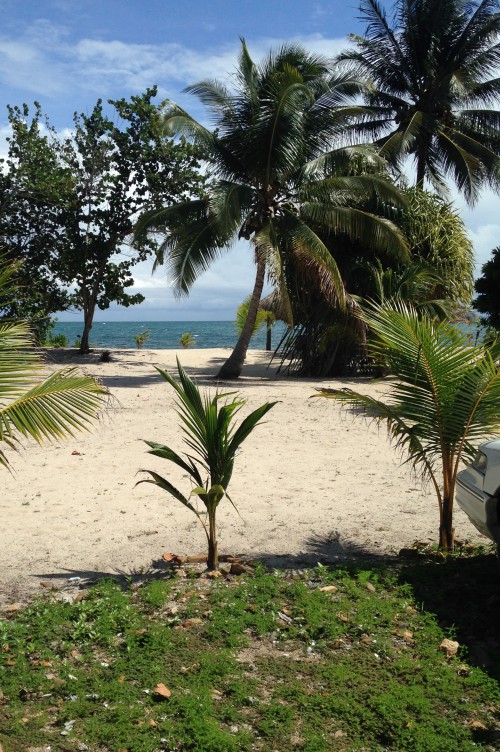
A week ago I returned from a blink of an eye trip to Placencia Village, Belize, a touristy beach peninsula with one main road. The transition back to school and its surroundings, even after such a brief excursion, was rough, but I think I’m back.

IMG_1543
Technically we are here on tourist visas, 90 day stamps issued upon entrance. We can’t tell immigration we’re volunteers. While the school’s attorney works on our residency visas, something that is years in the attempt, we have to leave the country every 90 days, linger outside the border for a few hours or days, and re-enter. Guatemala isn’t good enough because it’s in the CA-4 region. The closest qualifiable escape destination is Belize, an 11 hour, 5 bus, 1 boat journey, plus 1 more and a taxi since we went to Placencia. Add in 2 currency exchanges and 2 border crossings. All for a two day stay.
IMG_1541
And what a stay it was. NevMy roomer have I so relished having my own room (see: A Room of One’s Own), hot shower water, potable water from the faucet, the ability to flush toilet paper, a reasonably quick internet connection. Consistent power. Consistent water. Miles upon miles of town to wander without accompaniment. The locals and I spoke the same language. (English is the official language though most speak Spanish or Creole as their home language.) These are all things I’ve taken for granted during my life, except for the past three months.
Oh delicious solitude here in luxury let me compose an ode to thee…the quiet, the independence, the crickets calling in the night.

Our inn was a minute to the beach, if that. Being the offseason, a little stormy, it was mostly deserted, a little seaweedy, with trash among the weeds. Between the inn and the sand ran a skinny sidewalk—or the skinny sidewalk that the town is known for—that I ambled down to the tip of the peninsula to find breakfast at a spot known for its smoothies and stuffed fryjacks, doughy pieces of bliss filled with beans, eggs, and cheese. That first morning, after breakfast, I walked along the shore, back to the inn, sandals in hand. I waved to one or two locals, admired the vast blue-gray water spreading west, calculated how to move there. Calculated how many meals I could reasonably squeeze into my stomach in two days. I observed happiness.

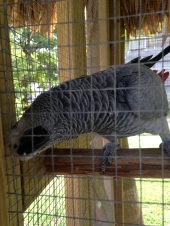
The Copán trip was full of aOliverdventures; this was much quieter. I swam, exposed my thighs to sun, read in my room, on the porch, on the beach, in a cafe, avoided, mostly, the other volunteers, except for a brief bike ride north of the village center on new bikes with extremely uncomfortable saddles, and met a parrot named Oliver. I met two delightful women who run a cafe called Brewed Awakenings. The cafe served espresso, even decaf, chai lattes and kombucha (what?!), and delicious, luscious shakes with seaweed powder harvested sustainably. They stressed the coffee was roasted and the chai spices grown locally. (“Sustainable”? “Local”? Haven’t heard those emphasized in awhile.) The women, who spoke different Creole dialects, I was informed, admired my hair on the first visit, greeted me familiarly the second, and gave me a departing hug the third and final time. I wish I could have tucked them into my pocket and carried them back. Surely the locals need to experience the joys that are chai and kombucha and sustainably grown seaweed?

Delightful sums up those 2 days. I don’t like thinking too much about the trip, actually, because the transition back to life here, reality some would say, was painful, literally. Respites are necessary but the cost of re-entry may be too high at the moment. I fantasize about the solitude. The reading a book on the porch with frequent breaks to watch the cat descend the stairs into the rain at the house across the way. Walking along a deserted sidewalk to breakfast. Swimming alone in the ocean, chasing the waves. No one needing anything from me. And not worrying about anything. I could have done that for a very

long

time.

Sign: Judge a person by the contents of his character not the color of his skin.IMG_1551
As I wandered, I wondered, of course. How can I have these moments of happiness more often, not just while I’m in Honduras, but ever? Or not happiness, but satisfaction and contentment, with bliss highlights. Over the past few years I’ve read so many blogs that say you get those by Doing What You Want Or Are Good At. Often this means the blogger is on a beach making money writing a blog about giving out advice on happiness. It’s circular, isn’t it? The people who are happy are writing blogs about how to be happy. So to be happy I should just write a blog about how to be happy, but anecdotal evidence and cherry-picking pop psychology aren’t my style, neither is cleverness, obviously. All this aside, how do I get here, to this beach, to what it represents? I want to believe that it can happen for me, but I don’t. I think it requires a sparkle of magic dust or a massively huge sense of self-worth that isn’t growing in this little garden.

I met a man from Vancouver B.C. who moved his family here a few months ago. They’ve rented a house for a year. Yep, the dream is real. I didn’t inquire after his secret, but our conversation lead me to suspect money.

Well, those last bits are little downers, aren’t they?

Other interesting trip moments: Puerto Barrios, Guatemala—Look at all these women driving and riding on motorcycles and mopeds!

Rapidito to Frontera (border), Honduras—A 60+ year old Guatemalan man and I have a very rough conversation. Honduras is dangerous, Guatemala is beautiful, he has a friend in New York, or maybe it was Florida. I enjoy the conversation but wonder if I should be worried that he will get off at our stop and then want something. This is actually something I fear in any stranger-meeting conversation, no matter where I am. Sigh. Introversion + anxiety = distrust of anyone.

Placencia grocery store—Should I buy this dark chocolate Milky Way bar for the shear reason I haven’t even had the option in months?

I suppose I will end this post dangling and unresolved. I want to keep Placencia in a little bag like some precious object. Once I was happy here.

Permanently,

theresa

Me with a bike, looking bad ass.

I attempt to look bad ass with my purple bike.

textbooks

Impossible science

I’m not feeling this blog entry today. I’d much rather be escaping into The Princess Bride, which I splurged on during a NOOK $2.99 sale yesterday, but I’m afraid of losing my routine. I promised myself that I would try writing again during this adventure, after years of fear squelching the urge. I suppose I’ll have to make peace with the imperfection, reluctance, and negativity that will be this post.

Today was the monthly teacher meeting between the Honduran and volunteer staff. It began at 8 a.m. It was in Spanish, which is great practice for my listening skills, but that didn’t override the earliness of the meeting or its devolution into circular, seemingly pointless digressions or that it lasted over three hours. I just wanted to put my head on the desk and cry, especially when “Thanksgiving” was mentioned, a day where each volunteer brings a specialty dish of his/her country (It coincides with the U.S. Thanksgiving, which doesn’t make sense considering half of the volunteers are not from the U.S., but let that go.), or when the school Olympics were mentioned, a yearlong event that includes, as I see it, additional opportunities to do school work outside of school hours, or when I learned that our winter break would be two days shorter than first reported. When I’m unhappy and lonely, I get ugly inside.

I want to quit, I really do. I want to be on that rooftop in Copán, reading a book and drinking coffee. In one of my early posts I mentioned that as tough as the previous school week had been, I wasn’t dreading Monday; now, I am, because when I think about preparing my science classes, I get nauseous. I should be planning right now, except I deserve this one day a week to myself. Exams are over and we’re in our second term (or parcíal). During the first, all three grades were learning the same science topic, albeit at different speeds. It was tough enough then to design the curriculum, from scratch, based upon the at times obscure learning goals set by the government. (I consulted /r/scienceteachers for terminology translation assistance.) Now, the curricula have diverged and I have two different topics. On the plus, I have four biology texts to choose from; on the negative, none of them have all the information I need and I must, again, rely too heavily on Google (animal nutrition, anyone?). I must somehow find interesting projects that are cheap (my pocketbook), need no science equipment, and require materials that are locatable in town in a day, because forget about planning weeks ahead, or days, I’m usually planning everything that night, with “look for interesting projects” on my continual to do list. And no matter how interesting I try to make my lessons, the behavior and complaints derail me. Whenever I think of the teaching advice “Be the most interesting thing in the room,” I want to kick someone.

Previous years’ science teachers didn’t do this. They just taught from whatever books they had and taught all three grades the same science lessons. Last year’s teacher gave a lot of worksheets and free periods. He had time for several tutoring gigs outside of school. I suppose I could do the same, but I was told that our graduates were barred from entering some bilingual high schools because their science knowledge was sorely lacking. Am I asked to do the impossible? Am I asking myself to do the impossible? As in, give these kids an excellent science education when I have absolutely no training in science and three weeks training in teaching English, and the school has minimal resources for me to give that excellent education and the classrooms are so loud, even when my students aren’t speaking, that I have to shout to hear myself? Probably, but I want guide my students to the marvel and wonder that is our universe, from the stars to the cow’s four stomachs. These kids deserve excellence, especially the ones that love science, that ask me the most weird and wonderful questions, the geeky boy on scholarship who wants to join NASA.

You, dear reader, may be thinking that I’m a perfectionist, and you can join the queue of disbelievers when I say I’m not. Perfection is impossible. I do, however, strive for excellence. I have a strong sense of obligation. I have been charged with a task and must do my best to carry it out; I just know that my best isn’t good enough. There are gaping holes in the knowledge I’m passing on, simply because I don’t have the time to re-understand what I learned at my students’ age. The work I put in does pay off. I am some of my students’ favorite teacher or science is their favorite class. I explain things clearly and well. I’m patient and “gentle.” These are comments written on my students’ parcíal exams (Bonus point – What do you like or dislike about this class? There is no wrong answer!), and I’d like to think they were honest. I allowed a few hours to glow. And, yes, a student did write that my class is boring, and I thanked him with a genuine smile and gave him the bonus point. But right now, after a few weeks of depression and sadness and frustration, I am asking myself what my effort is costing me. None of the other volunteers plan as much as I do. My roommate often does hers at the last minute. And while I have the reputation of creating amazing lesson plans, at least for English, I am sure they all think I’m a little crazy for spending four or five hours a night planning. But if they had to teach advanced science, maybe they’d put in the hours as well. Or not. Because the previous teachers didn’t.

Anyway, I am thinking about how long I can sustain this, about the cost of being here. Yes, there’s the monetary, but I mean the psychological. I don’t deal with stress well. I eat, I cry, I…. I’m lonely, isolated, and alienated. I share a room with someone (soon to be someones) who doesn’t see reading as a reason for leaving me alone. My only outlets of relaxation are reading, Netflix, and this blog. I’ve started running as often as my joints will allow, physical therapist be damned!, and that helps, kinda, except because I find running boring, I run with Vee, who complains a quite a bit. I have to wait until my stolen debit card arrives before I can buy a guitar (I wanted a banjo but those aren’t sold here.), something I think will help on Saturdays, my free day. I’m not learning Spanish. While don’t regret my choice and all I miss of Portland is one person, I often wonder if I should have just wandered Central and South America instead, focused, for once, on pleasure, but I thought I needed structure of some kind and purpose.

I don’t deny that there are fantastic moments, some of which I’ve shared here. This week the aunt of a sixth grader gave me a wonderful haircut for free. She is not professionally trained and usually does dying, styling, and trims. She was hesitant. In a town of waist length hair, it was probably the first short female cut she’s ever done. During the haircut, the sixth grader gave my face a makeover. The experience was undeniably sweet, and I will return. I gave an English lesson to the sister of one of my seventh graders. It was fun, we laughed a lot, and I was paid with a chocolate-cornflake licuado. Many of my 8th and 9th graders loved the video clip I used from Little Shop of Horrors in my carnivorous plant mini-lesson. I see evidence of improvement in the English of a few of my 7th graders, who are very behind. I love all of this.

Why are such moments not enough? I bask in their warmth, but the hole inside my chest gapes wider and resentment chills and fills it, and sadness. Why should I feel resentment when I made the choice to be here? Because I’m already giving so much, yet more is asked of me? Why isn’t it enough for me that I know I’m giving it my best, even when I fall short simply because I’m human and am being asked to do, well, something extremely difficult? Why do I still feel like a loser? Because it seems easier for the other teachers? because I’m not filled with the humanitarian-aid joie de vivre glow that pervades other volunteer blogs? because I’m still the awkward, reclusive, shy, insecure, impatient person I always am? because for once I just want people to see me and smile?

So why am I not quitting? Because I’ve made a commitment, because maybe this will get better, because I have nothing else.

And there you have it,

theresa

donuts

[insert title here]

This week’s post ran into a thick wall of depression yesterday. I tried scratching through but gave it up for Never Let Me Go, napping, and lesson planning. This is as much as I squeezed out, and I imagine it will return next week in some form:

Depression strong today. Weep-weep message posted on Facebook. I’m starting this post late.

I’m wondering today if I create my own loneliness. Of course I do. I can see the pattern, it is plain, I’m living it, as I have so many times before; and I’m living it because I’m me and despite how run, I’m still right behind. Hello, there you are. Here we are.

I haven’t slept well the past two weeks. Despite having early release school days and no lesson plans, exam week was exhausting.

My roommate talks and talks and talks empty words about subjects I care nothing about (calories, weight, washing her hair or clothes, gossip, how she’s gotten nothing done, men are bastards, you’re going to bed now?!), or she talks of nothing, but anything so she is the center of attention, and I lose my place on a page, the thought I am chasing for a lesson, the quiet I’ve tucked into. I smile a smile that reads complicity but is really communicating a Will you please shut up? And while I like to think I have a lot of compassion, empathy, and sympathy, especially when I can see her vast insecurity, I find my abilities being stretched. Home is supposed to be where I can take off everything that is not me.

She and another volunteer plan to go to Guatemala for Christmas break. Initially I was to go—hiking! volcanoes!—but since the itinerary includes significant partying, I’ve decided to find my own way solo. Nothing against a party, I do enjoy some bouncing around to happily frantic beats, but I prefer the company of people I trust. You know, every place you go will probably be just one big party, theresa, the message being that I should just suck it up and deal. The message being that I’m unrealistic, that I’m an ill-formed snotball. It’s just as well. By the end of Copan I wanted to be as far from her as I could. We don’t play on the same of side of most teams.

I was afraid of this, a reliving of college dorm life. But when I settled on working here and having to live in this situation, I figured I was older, had had enough therapy, and, for better or worse, this would just be another element of the adventure. Oh, and did I mention that our third roommate arrives soon?

[to be continued…]

Inescapably,

theresa

P.S. Those are some delicious donuts I enjoyed at Donut Friend in L.A. The dark one is chocolate with mint filling. It’s vegan!

7th graders

Schoolday in the life

My days start at 5:05 a.m. I’m the first awake in our four person household. I grab my smart phone, slip on my house flip flops, tug my REI quick dry towel from the nail in the side of the desk, and sneak my toiletries bag from my cubby. Outside the room I share with Vee, I fill my water bottle with cold potable water from the pitcher in the fridge. We buy the potable water in 5 gallon jugs or tambos. The jug is kept on a broken chair outside the fridge. I like thinking that lifting it to fill the pitcher will make my arms more muscular.

Water, bag, and towel in hand, I head to the girls bathroom. (There is a boys bathroom for our male housemate, thank goodness, because he is 20 and attends to his hygiene in an age predictive manner. But it’s not perfect—the wall between the rooms does not go to the ceiling.) While peeing, I turn on the sink faucet to see if the water is working this morning. If it rained the night before, the water is probably off. Supposedly the rain overwhelms the sewer system and officials turn off the water supply because they can’t guarantee the water is safe. I put my used TP into the pink and white trashcan and flush the toilet normally or with a bucket of water from the pila. I stopper the sink with a bottle cap and wash my hard contacts. If the water is on, I rinse with the non-potable faucet water, then water from my bottle. If it’s not on, I just use the potable water. The shower faucet is a thin white PVC pipe jutting through the exterior wall. It’s operated by a small lever on the top, labeled ‘cold’ by way of a thin blue rubber covering. Sometimes the water is a trickle, other times it’s a sputtering spray. Its temperature ranges from cool to goose bumps cold. I take a breath and dive under. I don’t complain or notice it much; it’s a fact of my life.

After shower, after my feet are slightly cleaner, I clear the teensy ants from a plate and breakfast on a quarter of papaya and a hard-boiled egg. I open the glass slats at the front of the house to welcome the slight morning breeze. The sunlight grows quickly. The street is relatively quiet. I check my phone in hopes of electronic missives from my other life, then browse reddit; aww pics are too slow to load.

Then comes all the other routine morning activities like dressing, pig tailing, applying essential mosquito repellant to my legs, and skimming that day’s lesson plans to see if candy prizes are required. I pack a snack for recreo and about two bathroom trips worth of toilet paper so I don’t have to rely on the office roll, which might be nonexistent that day, for my tiny bladder. Then it’s 6:30 and off to the Big House where the busito, a type of van that serves as hired transport, picks us up. I would much rather walk the mile or so to school but the school funds this ride. Also, the distance includes a not so safe stretch of road.

Sitting near the front of the busito has advantages; I’m one of the first in the office to print documents or make copies, not that the two printers or the copier are reliable, and they certainly are not fast. Some days only one of the two printers works, some days neither. Only one recognizes my flashdrive so I also save my documents on Vee’s. I handwrite my worksheets and tests if I can. The copier jams at least once per copy group and more if I’m trying to copy double-sided to “conserve” paper (quotes because a lot of those copies get trashed). So I always have a back up plan in case a worksheet or picture doesn’t happen that morning. I bring my own paper since we are restricted to the amount of copies we can make each day (one page per student per grade, so if Vee makes copies for 8th grade, I can’t use the school paper that day).

Copies made or not, I grab some TP from the office roll and venture to the girls bathroom, where only one stall is adult sized; the rest require me to grab onto the wall for balance as I squat awkwardly over the seatless toilets in such a way that my head or knees don’t hit the door. A trash barrel full of water and empty jumbo condiment containers is stationed outside the bathroom. I fill a container with water and then bucket flush the toilet. Some kids don’t do this; it’s obvious. The floors in the bathroom are wet from the water splashing into the toilets. (Now, there is a “teacher” bathroom with toilet seats and privacy, but it’s often locked and the loos are shared with the little kids, who can make a mess. I’ll take the discomfort but reliability of the girls loo.)

Then it’s to the teachers room to review, organize, or, depending on my mood, just plain hide until 7:15 a.m. and the first bell. And we’re off! Mondays start with Acto Civico, a school wide assembly that includes a prayer, the national anthem and pledge, presentation of Star of the Week for the top English and Spanish students in each grade, and a Honduran teacher rambling on a topic like respect or community. At 45 minutes, the kids standing the entire time, occasionally in the sun, this assembly is much too long. Often the speakers can’t be heard. Two kids are on stage the whole time, holding the national flag. My 7th graders squirm, talk, and whine. But, on the plus side, the assembly fills first period.

I start and end my days with 7th grade. Between these times I hop among the 7th, 8th, and 9th grade classrooms. I shout over the sound of four classes of kids and strain to hear my students. I sweat and gulp water. On off periods (I teach an average of five classes) I grade and plan in the teachers room or an outside table. Recreo includes the snack I brought and, inevitably, because I’m frikkin’ hungry, fried plantains with beans and disgusting cheese shreds, which don’t energize so much as leave me yawning, but food options are limited and always fried. The food at lunch, where half of the volunteers choose beans over meat since the latter tends toward toughness, usually consists of rice, beans, tortillas, and some sort of salad or fried vegetables or tajadas, and salt, always salt. The volunteer coordinator, who assembles our lunches, considerately leaves off wheat-containing foods from my plate. Occasionally there is a fresh squeezed juice—melon or pineapple—and always a sugary drink in plastic bags that you open by biting off a corner (true of many drinks here, including water. Empty bags litter the streets.). I avoid these. All the volunteers wish for more vegetables, but at least our food is free. During these breaks we are responsible for making sure the big kids don’t trample the little. Kids stop by to chat with their favorite teachers. A few of my 7th grade girls visit me, more often Vee, of whom they are huge fans.

School ends at 2:10. I sit on the low wall outside my classroom, sapped of verbal energy and longing for a small dark room to collapse in, and prevent my kids from rushing the gate. Kids are picked up by busitos, moto-taxis, and family members. Two fruit vendors and an ice cream vendor linger outside the double-doored gate, awaiting the mob of kids and adults, including me (green mango slices with barbecue sauce and salt, 5 lemps). The volunteer teachers—most of the Honduran staff is long gone to the public schools, where the second shift starts at 12—wait until the last kid is picked up. Inevitably, a ride is late and two volunteers wait at the school with the kid, and the rest of us, except those who accompany kids to their houses for tutoring, high-five Don Chepe, the daytime guard, and return home on the busito, driven by the father of a smooth talking and self-proclaimed womanizing 8th grader.

I invariably get off the busito at the town square to pick up produce, fresh tortillas, or school supplies. On Fridays I purchase a celebratory licuado (chocolate and banana or cornflake and papaya) from a small stand surrounded by a multicolored fence.

Once home, sweat drenched clothes are peeled off and replaced with boxers and a stretched out tank top held together with a safety pin. I make decaf coffee in my itty-bitty press (Thank you, care packages!) and allow myself a little time for texting and email and blog stat checking, maybe some feet washing—sandals + dirt + anti-mosquito spray = stinky—then it’s to the internet for research and lesson planning, unless the internet or power isn’t working, in which case I just hope that I have enough information for my next science lesson and look through old plans and notes for interesting English activities. The kids next door return home from school and start yelling and playing football, the ball regularly banging against their metal gate. The neighbor across the street blasts music or the next door neighbor parks his moto-taxi in front of the house to do the same. A little girl stops by our house multiple times per day to see my housemate Ky for her English lesson, to give her a gift for the lesson, and then to check on the time for the next day’s lesson, despite it always being at five. Ky’s room is in the back of the house; I answer the door. Vee is chatty. The house is disruptive, my focus tenuous. I wear earplugs almost constantly.

Dinner is simple, often ayote or broccoli and red beans and tomato and rice sautéed together in a battered pan on a match lit gas stove where the burners operate on high only, with avocado chunks stirred in.

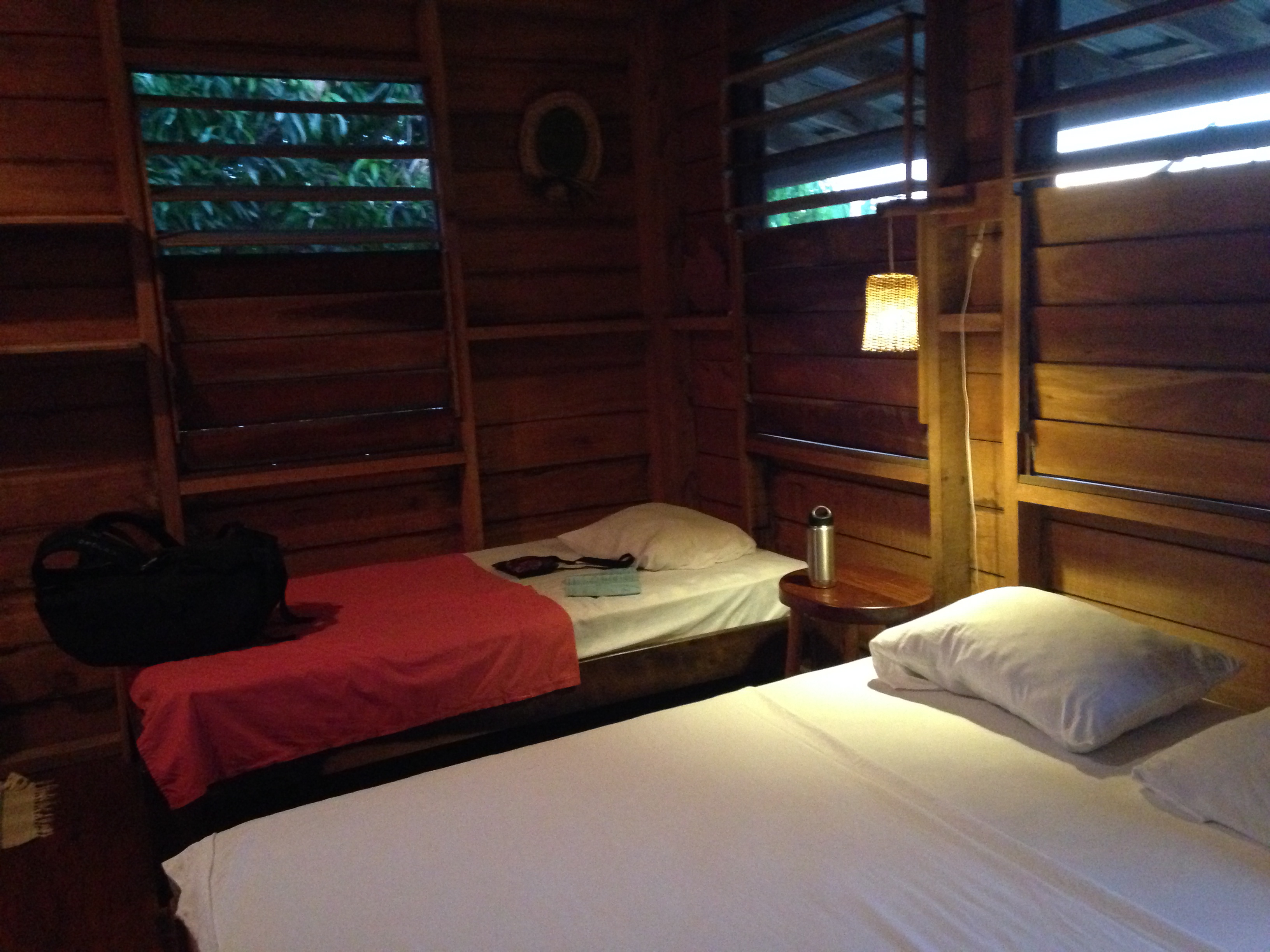
I try to end lesson planning by 8 so I can have a little bit of reading time before bed at 9. It doesn’t always work that way, but that’s my goal. I clear my backpack and computer from the bed, shake dust and bugs from the sheet, turn the ceiling fan on high, and collapse onto the pillow.

And so another day is done.

Still here,

theresa

Stickers

Detention, stickers, and earworms

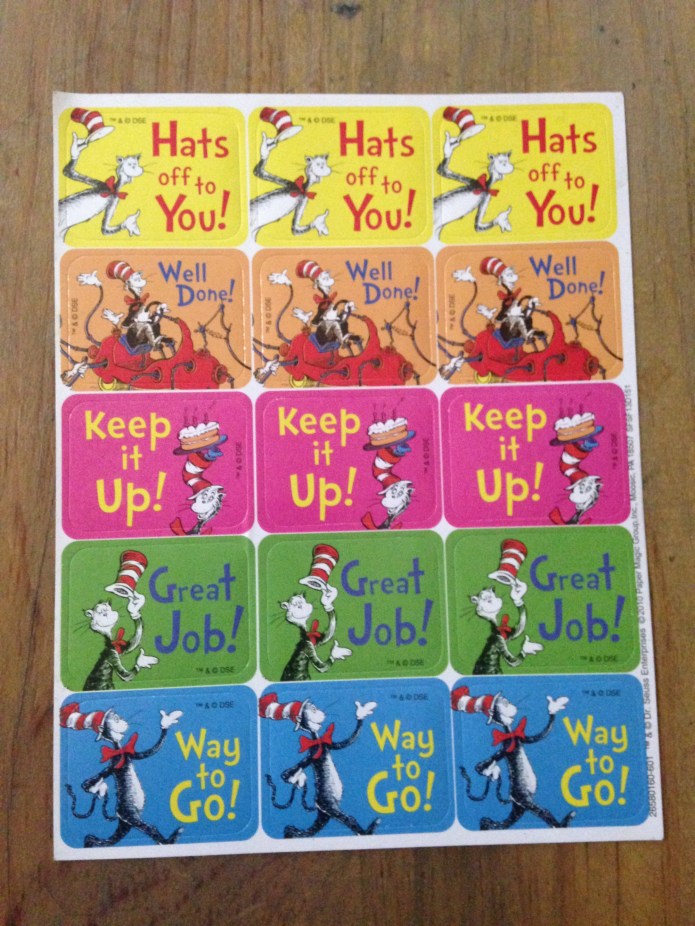
Joe, along with six other of my seventh graders, has a two-week old behavior plan. At the end of each day I complete a sheet outlining his homework, assessing his behavior on a scale of 1 to 10, and providing any explanatory notes on behavior, either positive or negative, from a stock collection of phrases translated for me. A parent is supposed to review and sign the sheet everyday. Of all my kids, Joe is the most challenging. He talks almost incessantly and flings rubber bands across the room. He and another boy make porno-quality moaning sounds when my back is turned. Joe has massive goof potential and speaks to me in a loud silly voice and echoes me when I say “thank you” to him or one of the other students. His hair is light brown and styled with gel, he has long eyelashes, and like almost all the other boys at school, he is obsessed with football. He rarely does his homework. If I chastise him about anything he claims that I’m treating him unfairly because he’s a boy. He loves girls and has a good imagination. His attention span is fleeting. I like Joe quite a lot.

Many of my kids have stories of poverty, abuse, and violence. I don’t know if there’s a story behind Joe’s behavior. He’s known as being particularly problematic for all his teachers. At the recent parent meeting, which included the parents of the other students on behavior schedules, his dad (or uncle? This was never clear.) gave a bit of a speech about how tough things were at home. His parents are divorced. Joe throws school notes away or stuffs them under the seat of his busito.

My seventh graders remain a troublesome class, but (and because) I’ve been reluctant to impose punitive measures, probably because they weren’t necessary for me. I don’t have any stories of talking back to teachers or cutting class (The one class I did skip was on my 18th birthday and approved by my teacher, so that doesn’t really count.) or sneaking a smoke or drink in the bathroom. I took notes, raised my hand, did my work. I wanted to succeed and understood that I would have to do the work for this to happen. So I keep thinking that my kids will have the same understanding and that if my lessons are creative and interesting enough, I will tap into their latent desire to speak better English or discover the origins of the universe rather than gossip with each other and style their hair. My co-volunteers, more daring and rebellious, understand the kids’ perspective much better than I. They all have encouraged me to put names on the board, give detentions, because actions have consequences and the kids have to learn that. I know this is right, but it’s just so…negative. And these kids often get a lot of that negativity at home because yelling and hitting aren’t taboo here. Some parents tell us to smack their children if they’re acting up. I like giving out stickers and saying “thank you” and making people happy. I dread conflict; it makes me nauseous. I have too much self-doubt to hand out detentions. What if I’m being too hard? What if I punish the wrong kid? And what if they get mad enough that they stop talking to me and become even more disruptive? What if I’m wrong or unfair?

What finally pushed me onto Team Detention was someone pointing out that my reluctance was an unwillingness (my word) to work within the culture. The kids are used to the negative reinforcement approach from their Honduran teachers and parents. It’s what they know and expect; it’s their school culture. One of my TEFL books noted that it would be necessary to learn how to work within my students’ culture. The example it cited was Chinese students’ discomfort with volunteering answers and calling attention to themselves. They were used to attending lectures and taking notes. The teacher in this situation compromised her cultural expectations by letting the students compare answers in groups first and then calling on a group representative to give an answer. While all the other advice I was given on the issue was wonderful, citing my cultural inflexibility helped the most.

Not that it has been easy summoning the God of Names and Tallies on the Board for assistance. Every name earns a “Whyyy, Miss?” whine and a “Why aren’t you writing her/his name down?” and, if it’s Joe, desk banging on the floor. The students continually tattle on whose name belongs on the board because of something I didn’t see. I prefer the school of self-responsibility, but they also don’t understand that and, I admit, it isn’t much supported by the school, where kids throw their food wrappers on the ground for the cleaners to sweep up, ruin school property, and are promoted, even if their grades are poor. Obviously, they aren’t ready yet. Maybe we can get there.

In the meantime, while tallies have invoked more quiet, they have also invoked glares and whines, and my poor lonely heart wavers. I love making people happy, I want my kids to have fun, and, despite my protestations of not needing to be liked, I do want to be liked. How could I not when I see the other teachers getting breakfast and stickers and candy and hugs and devoted affection from their kids, while mine are generally too cool for that sort of thing, and I have masses of second guesses and continual longing for reassurance that this is a battle that I am qualified to slog through? The logical part of my mind knows that my lessons, at least for English, are interesting, that I’m approaching everything with compassion, and that tough love really is necessary. I also know that my kids like me. I do get hugs, smiles, and “Goodbye, Miss” at the end of the day. But…. There’s always that but, that nasty little whispering earworm.

Back to Joe. Tuesday, I made tallies and Joe collected the unlucky three. Also, some girls left class without permission to get in the recreo snack line early. That earned them detention, too, and some pretty impressive yelling (thank you, vocal training), which two girls didn’t much care about. (One girl, perhaps my sweetest, Yu, left early for the snack line but without my observing; she gave herself detention. I wanted to waive it just for her honesty.) Joe fumed and yelled about unfairness. He wrote that he was in detention because I favored the girls and that he wouldn’t be doing this again. We sat through detention. Another student apologized. We parted ways. I felt exasperatedly invigorated.

Seventh grade class doesn’t much improve, but Joe and I finally connect on Thursday. That afternoon, the kids let me know they are having no more of this sitting quietly for taking notes nonsense (and in retrospect they were right to disagree) and I divvy them into groups for some World’s Longest Sentence competitions. Joe refuses to join a group and asks to sit where he is, in a little desk island in the middle of the classroom (that day’s punitive measure). I reluctantly agree, but only if he practices Subject + Verb + Object sentences. A deal is struck. I circle the room, inspecting sentence competitions. I return to Joe and his sentences. They are perfect, even complex. The best sentences I’ve seen from him, from almost anyone. He names the S, V, and O. I ask for more, circle the class, and return to more beautiful sentences. I give him stars, pats on the back, and praise. A lot of praise. I say he can write more or just sit quietly. He chooses the sitting quietly. His behavior report says 6/10 that day, his highest score yet.

Friday is a short day for us. I have seventh grade for only two periods and one of them is filled with an assembly. The class works outside in the afternoon on a mystery game. Joe is not only the first one done with the initial part of the game—drawing a picture and interviewing his classmates—but he writes up his accusation and 14 present progressive sentences regarding what the suspects were doing when Miss Theresa’s cows were stolen, and is the only one to finish. His report that day is 8/10, a Dr. Seuss sticker, and some garbled Spanish comment in praise of his participation. After school, I want to tell the world about his work, host a parade in his honor; I have to confine myself to a few fellow teachers.

My best teaching moments so far are these, when I’m able to meet with my students one-on-one and give them the attention they crave. At 14 students, my class is small, but they are all needy little buggers and the classroom is tiny and cramped and so loud because there are no full walls in this row of four classrooms. No wonder no one can focus. All of my troublesome kids love the spotlight of my attention. Unfortunately, one-on-one moments are rare unless I have an assistant or I’ve happened upon an activity that my kids will do independently for a whole minute before calling out, “Miss. Miss! MISS! MIIISSS!” They need more.

I have another story similar to Joe’s, a girl named Kim, who spent her time giggling and coloring and was too embarrassed to answer questions. Her friends would tell me she didn’t know English. But I had my doubts as to the veracity of this after our first written test when her mark was surprisingly good. It turns out, after separating her from her fellow colorer and having her mom review the behavior plans, that Kim has some of the best written work in the class; she’s started participating. She loves getting stickers and I love giving them to her.

Sometimes, no, often, what doesn’t work in class overwhelms me and I feel pretty hopeless. It’s these moments with Joe and Kim and Krissy and Fred and Antonio that keep me going. My kids drive me batshit crazy, I doubt daily that I’m going to survive the next eight months, and I wouldn’t exchange these moments of connection for anything.

theresa