Macaws!

Copán: Ruins! Parades! Hot Springs! Hammock!

It’s been a long two weeks since lovely Copán, since reading in a hammock while the rain thunders on the tin roof, since eating a slice of flan de cafe – que rico!, since the significant decrease in my stress levels.
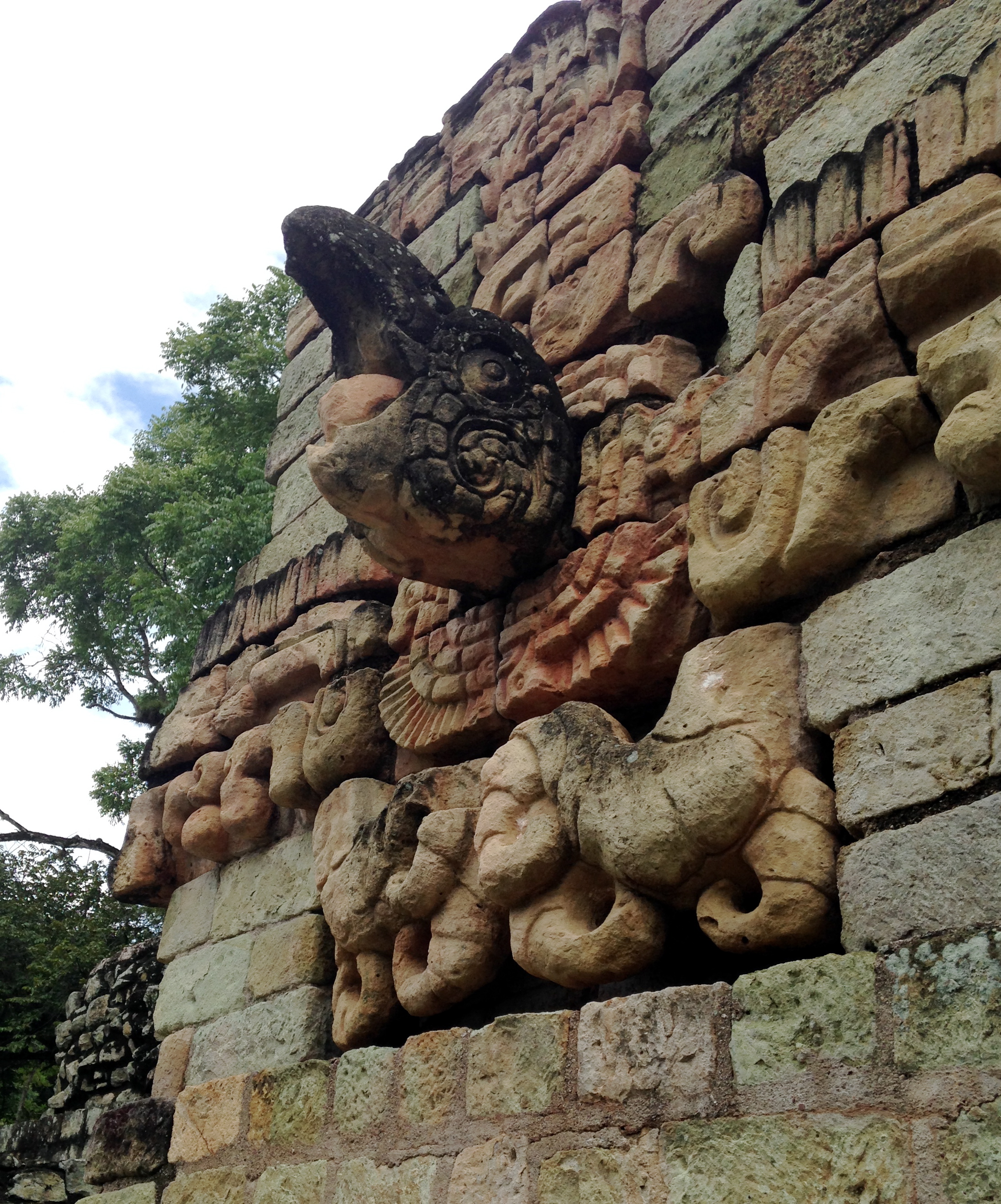
GargoyleThis will sound strange, but my favorite part of the Ruins is the macaws. Near Copán is a macaw rehabilitation center. Once the birds are healthy enough to start being reintegrated into the wild, they are brought to the Ruins and supplied with food, sheltered perches, and freedom to explore the park. The birds’ plumage is early Technicolor, like Wizard of Oz or Oklahoma! The reds and yellows and greens pop like freshly applied paint in an Andy Warhol painting. The birds swoop and soar between the trees. They screech loudly and repeatedly. At one point we are in the middle of a group chatting from the depths of the tall trees. Two birds on a branch are fighting or flirting. There are no cages, no signs, only trees, noise, and these birds. They are fantastic, vibrant, and this is definitely one of those Mr. Macaw, I’m not in Kansas anymore moments.

The ideal way of experiencing the Ruins must be with a guide, because while there are signs explaining the ages of the statuary and pyramids (600 A.D. onward), their context is a cipher. That’s not to say I am not awed by the structures, only that I don’t have enough context to fully appreciate them. I have to admit I have a difficult time in museums. I often need a story, not just the facts, to fully appreciate the artistry. I’m a little embarrassed of this failing as a semi-educated person. I will return to Copán in the spring and will definitely hire a guide to explain just what that tortoise means and the pyramids and the symbols on the altars.

Monday starts with chasing the Independence Day parade(s), because I love marching bands. The sound and feeling of thundering drums combined with thick brass—forget the winds—gives me chills and teary eyes. In 2000 (according to IMDb), a small movie called Our Song, about three Brooklyn girls in a high school marching band, came out. It opened with the band playing and I immediately teared up. Between the drums and bittersweet story of friendship, my eyes were not often dry. There’s a band called The Last Regiment of Syncopated Drummers in Portland that I fantasize about joining.

Lovely ladyWe stand in the town square crowded with food vendors, kids in school and band uniforms, occasional tourists, and a young woman with a golden fan headdress topped with dried grasses and long woven skirt of the same dried grasses, surrounded by people with cameraphones. It’s unclear if we’ve missed everything. Then the drums and glockenspiels start at the opposite end of the square. The sidewalks fill with onlookers. I stand on a wall, unable to see anything (the visual element seems important for the chills), but ten minutes in, drums start on another side of the square. I dash over and have a front row view of the drummers, glockenspiels, and kids with pom-pons and banners expressing peace, god, love, and history. My nose tingles and weeping beckons, but I hold it in. Once that section of the parade moves on, another band starts at a third side of the square. I never do figure out if the parade has any official beginning, because as soon as one section of it ends, another section starts elsewhere, this time a block in the opposite direction. The parade is modest, with the occasional vaquero or traditional dress outfit, but mostly school uniforms and banners. So many schools for such a small town, at least 15, and the bilingual school is so much larger than CBS…and the female volunteers teachers are mostly tall, strong, and blond—is this a requirement? There is a float of Noah’s Ark and a crowd of kids with Halloween masks. Many of the kids wear sunglasses, lending a secret agent or too cool for school feeling to the whole event. I lose my fellow volunteers early on. A whisper wonders if they might worry and try to call my phone, left behind in the room, but I just don’t care. This is for me.

The final adventure of our trip takes us to the Luna Jaguar Hot Springs, a mostly beautiful and bumpy hour ride away on a rain-soaked mattress in the back of a truck, where Eza and I attract quite a bit of attention and whistles. I mentioned earlier not really fitting in with my co-volunteers. One-on-one, conversations about topics other than drinking or mocking classmates from high school can take place.
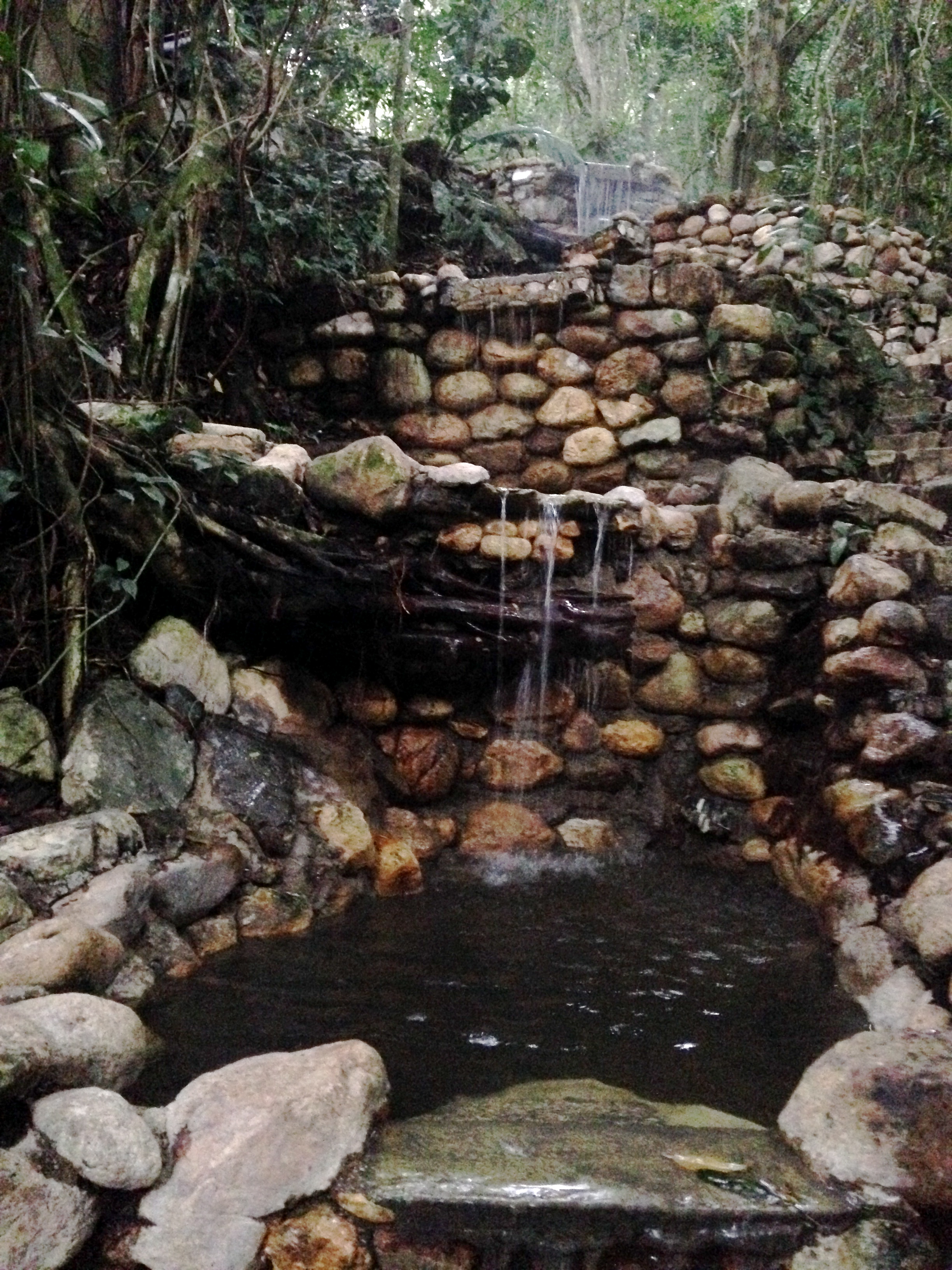
hot springsI’ve always wanted to go to a hot spring. There are several near Portland, but…it’s just never happened. For some reason the adventures close to home rarely are explored. I can’t imagine any spring would ever compare to this, however, and, again, my descriptive abilities are challenged. It is raining hard. We are lead over a swiftly moving river across an occasionally slippery rope and plank bridge into dense forest. We pass through a narrow tunnel and to the right is a cascade of small pools. The path winds around and there are yet more pools alongside a stream. The pools are cloudy and surrounded with flat rocks. After a brief tour and explanation of the pools’ temperatures, we strip down into bathing suits—I am the only one without a bikini—and venture back down the stony path to the first spring, and then the second, and third, and beneath a warm waterfall, only to climb higher until we’re level with the top of a steaming waterfall. The rain has cooled the air so sitting in warm-to-hot pools of water in a humid environment is thoroughly pleasant, romantic, and I’m ready to move in. And it is so quiet aside from the rushing water; Honduras is not a quiet country. Until the very end, we are the only visitors. After at least an hour we conclude at that cascade of small pools. Each is warmer than the next until we reach the final, largest, and hottest pool of them all, too hot for everyone but me. I relish hot baths, especially in the winter when my fingers and toes are often numb and swollen, and if I miss any luxury on my adventure down here, it’s reading in a hot bath with a book. I soak and float, and by this time my feet, all of our feet, are cleaner than they have been in a month. Actually, the final pool is a cold water pool, and I do dare to slide my full body in , and it feels as if fine bristled brushes are pressed against my skin and my body were poured lead. I laugh.

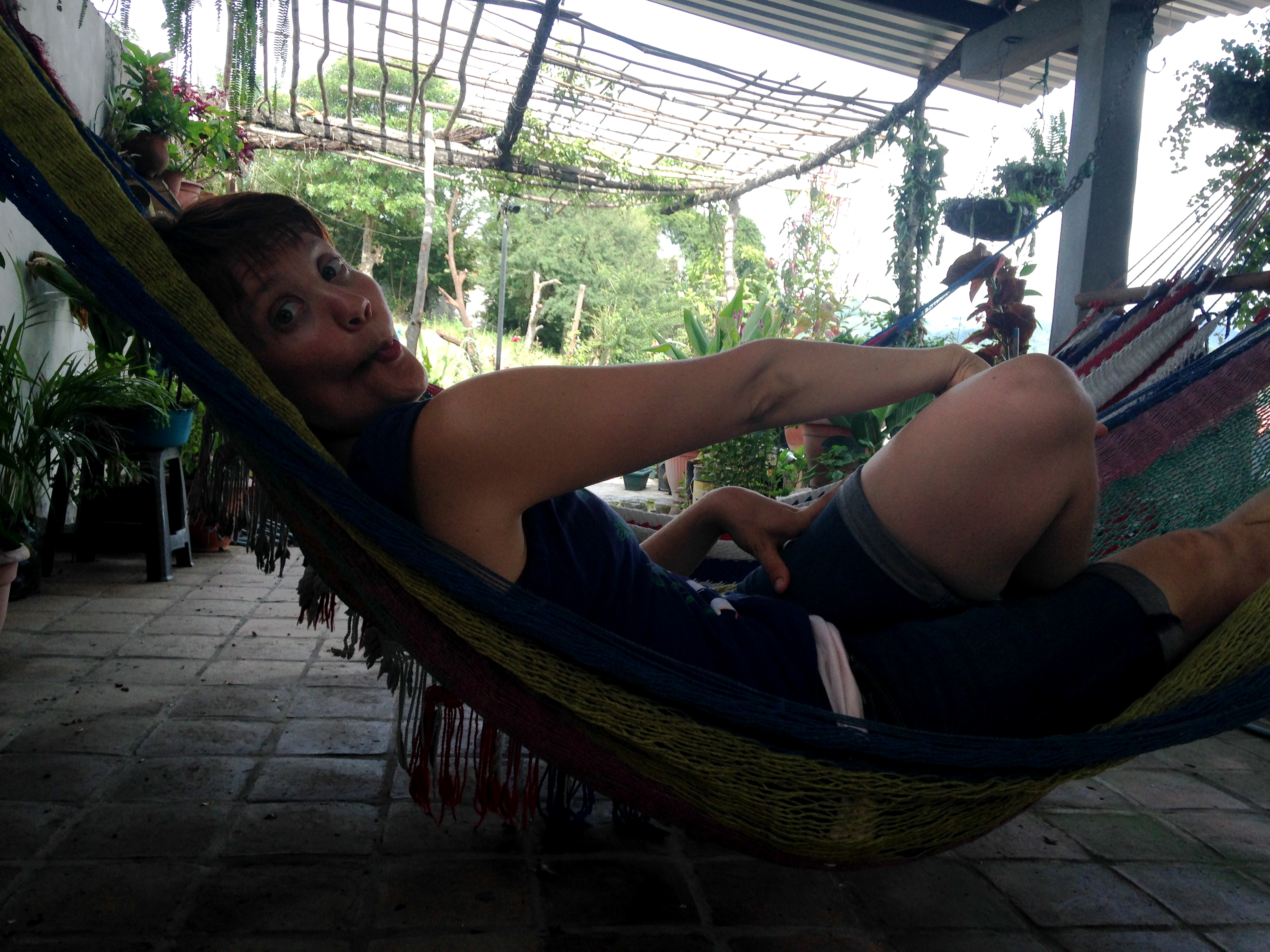
The other delights of Copán are small. I taste genuine pupusas, a type of cornflour pancake filled with cheese, beans, and/or meat, a foodstuff previously eaten only at home through the efforts of my unskilled hands; drink a decaffeinated (bad tummy) espresso; and spend several hours with a book (Cloudstreet by Tim Winton, and you should read it right now) in a rooftop hammock. I meet an Australian traveler who asks me questions, rather than the interest being on only my side (see co-volunteers). Also, speaking of whiteness, since the residents are used to tourists, there is much less gawking and catcalling. I see white tourists and Asian tourists. And we walk anywhere comfortably, without warnings of danger. The views from the hills of the city are spectacular.

For these days I’ve done my best to bury school in a dusty corner of my mind, yet it unearths, of course. We leave Tuesday morning, with minimal transportation drama. Then it is back to lesson planning and stressing over teaching the formation of the universe.

As I write this entry, the pleasures of Copán are difficult to comprehend, buried as I am in the dramas of school. I look forward to the next break, at the end of October.

Endeavoring,

theresa

P.S. I love you, Erpie!
Relaxing

Hotel porch

Copán: Horses! Money! Exploitation!

Remember the guy that lead us from the bus to our hotel? Vee decides to hire him for a two hour horseback ride through the Ruins, another one of his businesses. Now, my guidebook said that we would be mobbed by men who would try to “sell us overpriced horseback rides,” and I don’t want to be a Naive White Person Who Gets Ripped Off. Plus, I distrust anyone who aggressively tries to sell me something, maybe because I’m so non-agressive or because I can’t think rationally under pressure. But I agree to go along in the spirit of adventure, and we pay half of the fee that night. To reassure myself that this isn’t stupid, I reason that the manager and our co-volunteers saw us with this guy, who I’ll call Mr. G, so it is unlikely that anything horrible will happen.

Let’s just say Mr. G gets a little creepy. We agree to meet at 9 a.m. When we go down for breakfast the next morning, he is in the lobby. After breakfast, we wander around the town. He appears by our side and asks if we need a tour. At 8:45, when we return to the hotel and are admiring the view from our floor, he appears behind us, indicating it’s time to go. If Vee had decided to back out of the trip then, I wouldn’t have minded. Instead, we shoo him away, brush our teeth, then meet him at the appointed time. Surprisingly, he doesn’t ask for the rest of his fee right away. He waits until we are in the crowded town square, a most awkward time to be waving around our lempiras. Since he can’t break our bills, he agrees to accept fifty lempiras until after the ride, though that doesn’t make sense, because our bills won’t get any smaller during the ride, it’s how I remember it. We walk past the edge of town, where the cobblestones turn to dust, and I feel very white and foolish and am being stared at by a truckful of people. We approach three horses tied to a fence. A man, who I assume owns the horses and is paid off by Mr. G, chooses two and helps us mount. My feet aren’t too snug in the stirrups. My rope reins are too short. Off we go.

The ride—except for the part where Mr. G whistles to make my horse go into a trot, which is rather uncomfortable if the stirrups are too long for your short legs, and, actually, to be honest, it’s uncomfortable when you haven’t ridden a horse for 20 years—is lovely. It’s along the Copán River, thick, wild, and brown from the storm the previous night. The path is mostly deserted, tree-lined, and muddy. We pass bare tomato fields, feed grass fields, and cows. Vee is ecstatic. She loves horses and breaks into a gallop, far from my slow mount, often. That’s probably the best part of doing an off the grid horse tour—no rules. At one point Mr. G waves me off my horse and races with Vee. He obviously loves horses. My guess is that that is what he’d rather be doing, instead of giving white people horseback rides and scrambling around to make a living. But that’s just a guess.

Mr. G’s English is good enough, but not overly so, and if I were a suspicious person, I’d wonder if that is intentional. It’s never clear where exactly the “tour” ends. Initially it sounded like a horse ride through the Ruins. Then it was unclear if we would even get to the Ruins or if he would just point us in the right direction. Maybe he needs to work on his prepositions of place. In the end, the tour stops awkwardly in a field by a gas station, about a hundred feet past a security check point, through which Vee galloped, wishing the guards a “Buenos días.” We dismount, I wash the smashed banana-covered interior of my bag, and we walk to the entrance to the park. I am eager to ditch Mr. G at this point. If he had his way, however, we would hire his brother as our guide through the Ruins. Or we would hire him to give us a tour of the town tomorrow. Instead, we pay him the remaining fee, he requests a tip, and our tip is so poor, in his opinion, that we never see him again. And that leads me into another topic.

I’m not sure which bothers me more, being taken advantage of or not knowing I’m being taken advantage of. Because I’m white, there is an expectation here that I’m rich. Comparatively, I am. Being (over)charged 20 lempiras (US$1) instead of 10 for a mototaxi ride has no real effect on my wallet. The expensive breakfast I ate Monday cost less than US$8. The extremely modest savings that have afforded me this volunteer opportunity and my travels are more than most Hondurans earn in three years. In the States, I have a smartphone, internet service, and live in a house (shared) with running water, electricity, a backyard, and a refrigerator full of food. Those things make me rich here, and I don’t imagine it would translate if I explained that in the States, I’m far from rich. I could never have a vacation comparable to Copán. I was without healthcare for several years until Obamacare passed. I do ride a bike for health and environmental reasons, but I really couldn’t afford a car. And let’s just say that most of my clothes are worn out enough that it’s no problem for the colors to be washed with the whites. None of that matters, though, because as little as I might think I have, the people here and in many places, including the States, have even less.

World economics are anything but fair. I have benefited from their poverty and exploitation, so why shouldn’t people here be tempted to overcharge me, and why should I mind? Is it that the perspective of myself as a walking wallet makes me question my responsibility toward the world, especially as a U.S. citizen? My country is rich in part because it exploits others. It allows its businesses to exploit others, or The Others, the brown people, if you will. If I were a better blogger I would cite articles and facts here (smallpox blankets, anyone?), but do I really need to? This statement should not be in question. (If you, dear reader, want some facts thrown at you, just let me know in a comment or email.) While I did earn the money that brought me here, and my work was good and honest, it isn’t completely clean. I know and I’m not clean. I’m trying to figure this out, right here, on this screen you’re reading. I understand, even appreciate, the motivation to look at me as a cash machine, and part of me doesn’t understand why I don’t tell them, the anonymous faceless “them” of the world, to take it all. No, that wouldn’t do anything, really. That’s not how a lasting change will occur, but it would be a temporary relief, a bandage over my guilt, a luxurious feeling that is pretty useless to anyone.

While I suspect I’m being overcharged in certain circumstances in Copán, the awareness doesn’t draw emotion until the other volunteers point it out. They mention how they call out the mototaxi drivers and fruit vendors on their “steep” pricing (in quotes because everything, unless it’s imported, is cheaper here and I find it difficult to call anything expensive). While I had noticed the higher prices, I attributed them to Copán’s higher cost of living. It was then I felt shame, not from paying higher prices, but being told I should be upset about it. So when I went to the fruit vendor, I named my price, a lower one than what I had previously been charged, and she accepted. What did that save me? US$0.25. Maybe being overcharged doesn’t bother me. Maybe it’s being caught acting like an unsavvy traveler, which I am, but which, in actuality, in my true self, I don’t much care about. Not today, anyway.

Okay, here is the one overpricing that did upset me: we were told our room was US$11 each per night. Vee and I paid this the first two nights. Then, on the last night, I paid my share and the attendant, the mother of the manager, I presume, said we owed only US$1 more, not US$11 more. Apparently we had been charged almost double the standard rate our first two nights. That seems a bit egregious.

Also, I will say that being taken advantage of in my temporary home town does bother me because all the residents know that white people here are either Mormons or volunteers…and we’re obviously not Mormons!

And now I leave you with these deep thoughts. I’m sure you thought vacation time meant lighthearted, but that is just not my style. More Copan—the Ruins, the parade, the hot springs!—soon,

theresa

Las Ruinas

Copán! Getting there

In honor of Independence Day, school is closed from Monday – Wednesday. Five day weekend = travel! Seven of us decide to venture to Copán Ruinas, the site of Mayan ruins and most popular tourist destination in Honduras.

After a long Friday evening of drinking, most of the volunteers are not ready for travel at the agreed upon time of 8 a.m. Vee and I, two newbies desirous of adventuring as soon as possible and annoyed by our cohorts’ irresponsibility and rudeness, decide to attempt the journey solo. I purchase a stack of corn tortillas to ensure my fortification during the journey. Thus begins my life on the edge, because bus travel is different here.

New public transportation systems make me nervous, even in the States. When I first lived in New York City, for college, I chose to walk 40 blocks rather than try the subway system. What if the ticket machines were complicated? How would I find the right platform or know where to get off? What if I got lost? In Portland, despite many years of experience with the transportation system, when going some place new, and especially at night, I stare out the window, slightly breathless, tracking the street signs just in case my stop isn’t called or following my GPS dot on Google Maps. Now, NYC has large signs announcing each stop and clear maps that explain where each train goes; it’s easy to master. Portland has a comprehensive map and bus/train identification system, street signs, and I can always ask the driver to announce my stop. Here, there are no street signs or marked stops, buses are privately run with unclear, to a neophyte, routes, and there is no consistent payment scale. Some buses are large school buses, the (de)famed chicken buses, while others are small minivans known as busitos. Plus, my Spanish, well, is pretty bad. Such details do not inspire confidence. But, armed with the name, if not location, of the town, my guidebook, rumor of a direct bus, and a vague emergency plan, we set off.

I ask a young woman who runs a small shop, and who for some reason remembers my name, where the bus to Copán stops. She glances at her friend, a little uncertain, and they tell me to go to La Avenida Salida. Okay! That’s one step closer. I assume she means the street corner that is often crowded in the early mornings with bus commuters. We stand. I’m all for hanging out, confident we’ll know the bus. It’ll say “Copan,” right? Vee is less confident and asks at an eatery when the bus stops. Oh, it doesn’t stop there but at the highway. Okay! So now we’re at the highway with a bunch of other potential passengers but still uncertain as to the existence or arrival of this direct bus to Copán. I attempt some Spanish. A cluster follows our interaction closely. My responder, according to Vee, either says we just missed the bus or that there is no direct bus. We sit and consult the guidebook.  There are supposedly two bus lines that go to Las Ruinas. A man approaches us. Do we want Las Ruinas? If so, the next direct bus arrives at 11 a.m. I think he also offers to take us there. We’re approached by a young boy. The men at the food stand stare. We’re getting way too much attention. And it’s only 9 a.m. But then we see the Mormon missionaries, from El Salvador and Idaho. They tell us there is no direct bus and that we have to switch in La Entrada. Crap. They board their busito for the next town over and we plan. Again, we consult the guidebook. Buses pass. La Entrada is on the way to and a town called Santa Rosa appears to be close to Las Ruinas. Rather than wait for the possibly nonexistent direct bus, we’ll take the next one to La Entrada or Santa Rosa. Ah ha! Santa Rosa it is.

It’s a chicken bus and we’re standing. We’ll be standing for the next hour and a half as the wrangler stuffs people into the bus. The wrangler insists on putting my backpack on the inside overhead rack. Shit. That was not expected and my passport and extra money are in there.  Well, okay, I’ve got a copy of my passport somewhere and the money is just…money. I’ll watch my pack. Despite this surprise, the wrangler puts me at ease. He is quick and attentive. He remembers passengers and their stops. He does his job of shoving us into this tube well.Not only is there standing in the aisle, there is standing butt to butt with people in the aisle. We ride, and we ride, and it’s thrilling that we’re off, by ourselves, and things are going relatively smoothly. And there’s the beautiful, lush, lovely, verdant, untamed countryside passing by. About an hour and a half in, a seat frees. I stare out the window. The view doesn’t get boring. At major stops, vendors approach the windows with soda, candy, fried foods. They crowd the aisle of the bus, shoving these in our faces. It is loud and chaotic. Some stops are quick, others long, but there are many. It is at least three hours until we arrive in Santa Rosa de Copán.

Santa Rosa is the terminus of our current line. We step off and are swarmed by wranglers for other bus lines. They follow us. They shout in our faces. Vee and I surge out of this mass of noise and people. We cross the highway to find a place to breathe and plan. I need to pee; she needs a bandage. Her bandage comes easily; the bathroom…is a fluke. We step into a building that might be a hotel or shopping center. Vee suggests we ask the reception. We stand there, waiting for an attendant to be free, and a man sitting in what we think is the waiting area, in unaccented English asks, “What do you need?” Startled, I say, “The bathroom.” He points to a door. Success!

I won’t detail what happens next in Santa Rosa, but in summary a confusing conversation with an attendant ensues, we leave, a wrangler approaches Vee, and we follow him to a busito to Las Ruinas. Again, the lovely countryside, which truly defies my abilities of description, and also softer seats divert us. But the map was misleading. Actually, Santa Rosa is quite far from Las Ruinas. We really should have switched at La Entrada, but we were too comfortable at the time. This busito stops every few feet, or at least in every tiny village, and there are more switchbacks on this highway than a snake breakdancing. Our asses hurt, we’ve been traveling for several hours, and the blaring music – are we at a disco? – is monotonous. The thrill of adventure is replaced with concern that we will not arrive before dark.

But we do, around 5 p.m., and we are now swarmed with taxi drivers and hotel wranglers. Fortunately, we already know what we want; a co-volunteer recommended Hotel Mar Jenny. A man, coincidentally the wrangler for Mar Jenny (or a wrangler for many hotels), approaches and offers to guide us. We follow him up hilly, multi-colored cobblestone streets. In the twilight, I can tell this is no small town outside of San Pedro Sula. There is money here. He shows us to a room, which surprisingly has its own bathroom, and, did I hear correctly? hot water. It’s clean; we take it. All for USD$11 each a night. (Which we later learn is a rip-off, but more later.)

As we confirm with the front desk that we will take the room, the proprietress asks if we are part of a group. If so, our friends are already here. Yes, those hungover friends caught the direct line and beat us. Vee and I stare at each other. Our pact had been to not mention our long journey, but now we can’t avoid it. They will fuss and give us unrequested “should have dones.” But, you know, I’m really proud of us. I had a blast. This is what my trip is about – diving in, messing up, and finding a way to enjoy it.

More later,

theresa

Color Day

The schoolyard during recess or lunch on a Friday, or Color Day, when students can wear whatever they want after paying a small fee (fundraising), is a wonderful place. Instead of the standard khaki shirts and forest green pants/skirts, the yard is filled with splashes of every color and modern street clothing style imaginable. Small people-in-progress chase each other, play football, dodge footballs, walk arm in arm, eat, and chat with the volunteers. The faces are smiling and laughing and crying and open, open and waiting to be filled with their futures. The scene is probably interchangeable with any playground anywhere. So much joy and hope, but this week the scene became tinged with a bit of gray.

I’m one of the most open minded people I know. Passing judgment on anyone other than myself simply isn’t my style. (Visit my familiarity with the fence.) While the sexism of the community bothers me quite a bit, it’s cultural and how the people are raised. I’m here to teach English, not thrust my point of view upon my neighbors, though my belief in the equality of all persons will inevitably come across. So I’m troubled, as a self-proclaimed non-judgmentalist, that when I look at these boys running in the schoolyard, I connect them with the men whistling or making kissing sounds when I pass by or to the shopkeeper who pointedly ignored me before overcharging me for an avocado. Is it inevitable that these lovely young boys in the schoolyard, including my inquisitive geeky boys, will one day turn into sexist assholes? (Look! I just passed judgment.) My judgment gives me saddies, a slight despair, because those men on the corners could be intelligent, capable human beings, but the second they purse their lips or slide their eyes my way, I put them in a box and shelve that box in the dump. I understand but don’t like my all-or-nothing thinking, this dismissal of an entire person based upon this one characteristic, although it is rather revealing of his view of the other gender. It also gives me saddies that I purposely avoid looking at any male over the age of 13, due to this very characteristic. But I’d rather not appear to be inviting those much too young boys who leered at me when I went to make copies the other day; instead, I pointedly watched the Discovery Channel episode playing on the television. I don’t know how the male Honduran teachers would have reacted, but Friday, when my 7th grade boys whistled from the classroom window at a group of girls in the yard, I sternly told them to move away from the window and join the class. Maybe the male teachers would have laughed, or maybe they would have done the same as me. All I know is what I will not accept.

My gray visions also include the girls. Marriage happens early here, babies happen early, and on Color Day, some of these girls are dressed a wee bit provocatively. I remind myself that many of the parents of the students want different futures for their daughters. CBS is a private school. While even public school charges a fee, these parents have chosen to pay a higher fee in hopes that their daughters will learn enough English to get into a good bilingual high school and that their bilingualism will lead to better job opportunities or college. Motherhood is wonderful…when it is a choice. I despair the lack of choice.

I tell myself that nothing for these children, for any children, is inevitable. Given that the kids at CBS are exposed to teachers from other cultures and with other points of view, their views of women might be more egalitarian.

These thoughts probably aren’t worth spending much energy on, but I do, because I’m thinking of creating lesson plans that either subtly or not-so-subtly address my concerns, those noted above and a few others, like homosexuality, as other teachers have done. Maybe I’ll even do one about vegetarianism. What bothers me is that my concerns are indicative of my privileged US American point of view. Despite the rampant sexism and anti-open sexuality of US society, I still am allowed and can find an environment to feel and think the way I do, yet it is not my place nor my way to disregard or disrespect the worldview of others. So I am conflicted that I struggle to practice my non-judgment here, though as a female, how could I not struggle?

Those are theresa’s Profound Thoughts of the Week.

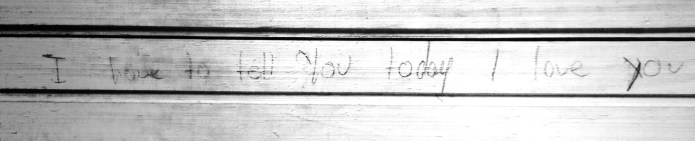
When I began exploring new careers, I wanted a job that actually made people happy, for once. I’ve somehow chosen the opposite. Or it’s just me. Let’s just say this week was harder than the previous at school, with multiple headaches, and it was all I could do not to bawl when my last class on Friday was dismissed. I put my head down on the desk and listened to music very loudly instead. All but two of the 8th graders failed their science test and got a stern talking to. (They’ll also get a re-try, which I’ll offer for most of my tests.) I suspect two of my 9th graders cheated. And the 7th graders, well, I’m trying. There were some positives, like the day the 7th grade boys worked hard on a project together, with almost no supervision, and one of my most troublesome girls actually listened to something I said. And there was the discovery of the above graffiti in the bathroom.

I feel caught between worlds at the moment. I don’t belong here and I don’t belong there. I don’t belong anywhere. But as long as I’m here, I might as well eat a bunch of delicious lychee/litchi fruit.

Still, I remain,

theresa

7th grade classroom

Because I’m mean

Friday, 29 August 2014, 135pm CST: I’ve sent the little shits on their way and they can kiss my ass. Okay, I’ve gotten that off my chest. It’s just that when I come up with a pretty darn interesting, or at least silly, lesson plan, and the seventh graders spend it whining and pawing each other, well, a person can get pretty down, for five minutes, anyway. Then I have to move on and plan the next lesson and hope that the next one is a little better. Thus concludes my first week as a teacher.

I teach Science to seventh, eighth, and ninth graders and English to seventh graders. The consensus among the volunteers, the majority of whom are in their second year here, is that the seventh graders, around age 11, are the most unruly kids in the school. The phrase “herding cats” has come to my mind more than once, even multiple times in a period. See, you have this group of cats and a few of them will chase the toy, but the rest are climbing on the scratching post, fighting over a dust bunny, or licking their butts. And when you show the latter group the laser toy it looks up for half a second and immediately forgets and resumes the climbing/fighting/butt washing.

Well, maybe that’s an exaggeration.

No, I’d say it’s about right, which is why I don’t take the long view but do this day by day. At least no one has died or even shed blood.

No one is sure why this class is…fill in the blank with appropriate descriptor…but it sounds as if this group has always been a little rebellious. In fifth grade (9 years old), instead of teaching their teacher the word for “beer,” the students taught him the vulgar word for “butt.” This teacher found out the truth the hard way. Supposedly the kids like me, so I could comfort myself that the cats could be worse. When I deserted them outside (it’s best to try to have lessons outside in the afternoon because the classrooms are so warm) because they wouldn’t stop arguing with me, they did follow me back to the classroom. I also get hugs from even the worst behaved ones. (Then why did you steal my pen and claim I had lent it to you?!) As for the title of this post, it is what I told one of my kids when he asked why I wouldn’t let him go to the bathroom despite the class being immediately after lunch and I have a pee before class rule. And, yes, at least one student has called me “mean.”

I’m certain that the readers who are current and retired teachers are nodding their heads and chuckling. Vee, who teaches eighth and ninth grade English, after the first day said she already had more admiration for her teachers, but there’s never a time I’ve not had admiration for them, at least the good ones, the ones who make an effort to interest their students and obviously care about them. I admire these teachers so much that I am skeptical I can walk in their shoes. Who I now have more sympathy for, however, are the defeated teachers. It’s gotta be so easy to turn that way. By the end of just this week, thinly veiled sarcasm was slipping out during my more frustrated moments. Sigh.

For now, the students who keep defeat and despair from consuming me are the eighth and ninth graders. While there is still chatter and boys socking each other, there is also note taking and kids answering questions and even asking me questions, some of which I know the answer to and others I have to look up at home. (What is the difference between silicon and silicone? Does lava have metal in it?) On Wednesday, when I wrote “Science!” on the board, the eighth graders cheered. I suspect that had more to do with the subject than my uneven teaching skills, but it still was gratifying to have a semi-willing audience. I have students, specifically two boys (my “geeky boys”), who deserve a more knowledgable Science teacher. In the right hands, they could go very far, as could many of my students. I keep thinking that these kids need better teachers than us mostly untrained, though dedicated, volunteers. The list of what these kids need and deserve is very long. Here’s to hoping that my own dedication is enough to get these kids into a good high school in San Pedro Sula.

I want to be more comfortable with failure. Rather than it being a gigantic, grayish white, much too thick and long-legged, possibly poisonous spider lurking above the kitchen doorway/behind the door/on the screen door that I have absolutely no interest in seeing, thank you for the offer, I would prefer it to be a pila water bucket shower — a little unpleasant, but each time I learn how to make that water last a little longer and rinse off more of the soap. I’ve failed here and there this week. I gave a science lesson that was rather confusing. I did not teach the English vocabulary words well at all and skipped the quiz. I’ve been unable to accommodate students who finish their in-class assignments early. I haven’t enforced the class rules consistently. I’ve hit a student in the face with an inflatable globe. But that’s how it goes, and I make note and try to do better the next time. I don’t dwell; there’s no time!

These are some highlights of the week:

  • Using hard boiled eggs to demonstrate the earth’s structure (9th graders grossed out, 8th graders interested, 7th graders…I think they liked it.)
  • Geeky boy comparing his zit to a volcano and the pus to magma.
  • Student regarding the inner core: “This must be where the devil lives.”
  • 7th graders creating colorful construction paper pictures of the earth’s structure.
  • Comparing the inner core of the earth to a marshmallow. A lot of pressure on both of them makes them compact and hard.
  • Challenging a geeky boy’s theory about why the dinosaurs disappeared in such a way that I’m pretty sure he’ll come back to me next week with an improved theory. This was a success because I was able to seem like A Well-informed Science Teacher Pushing Student Toward Growth and Research.
  • Lending The Giver to one of my more ambitious (and frustrated at my lack of behavioral management skills) seventh graders.

I wouldn’t say I’m excited for next week, but I’m not dreading it. I know I’ll be excited and hopeful Sunday night as I fall asleep. In the meantime, it’s Saturday and a day filled with food buying, blog writing, lesson planning, meeting with parents and teachers at school to plan El Día del Niño, and an awkward volunteer barbecue at the Big House (see previous post re: alienation) await!

ta ta,

theresa

8/23/14 The post that wasn’t posted

I’ve stared at the screen most of today, trying to find a starting point for this entry. Friday was the first day of school, and the entire week was busy with planning and training and school cleaning and fruitless emails with Vital Records and a trip to the nearby river. There were several times I wanted to sit down to sort the thoughts and emotions piling up, but none of them were very brave. I’ve fantasized about leaving most days, but the plane just circles.

Two days ago I wrote, “It’s been awhile since I’ve been this lonely.” And it’s not the loneliness of being in a place where few people speak your language, though there is that, of course; it’s the loneliness of being a circle in a crowd of squares, triangles, and trapezoids. The latter are different shapes but can still form bonds along flush sides, whereas a circle can join only at a point. In this case that point is being a volunteer. Being misshapen was also most of my college experience (student bond) and theatre experience (we are theatre artists bond), times when I was part of a close-knit community but simply never belonged, and I was continually made aware of it. Loneliness is a thread in my life, but it’s weaker when I’m not continually reminded that I’m just a little off. Por ejemplo, when someone tells a joke, I’ll get it but rather than laughing, I’ll analyze the language or the social situation it’s lampooning. Or I’ll force a laugh and then analyze it, either quietly or aloud, depending on the company.

All this to say, I’m really lonely right now, not that I’m not with with a bunch of terrific people (except one). And, yes, dear reader, it might get easier, but sometimes it doesn’t, and that’s just how it is.

As always,

theresa

Delay

This week’s post delayed due to lesson planning and a spot of depression. I’ve got a draft but it isn’t ready for the light. I hope to be back on track next weekend!

Barely swimming,

theresa

Snapshot

My home for the year is a small town of about 40,000 people, according to a fellow volunteer. Located 24km/14.9mi/a 1 hour bus ride away is the nearest and second largest city in Honduras, San Pedro Sula.

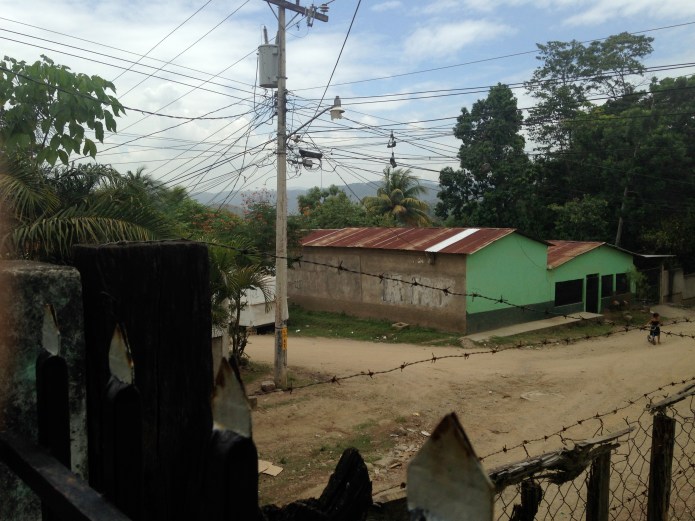
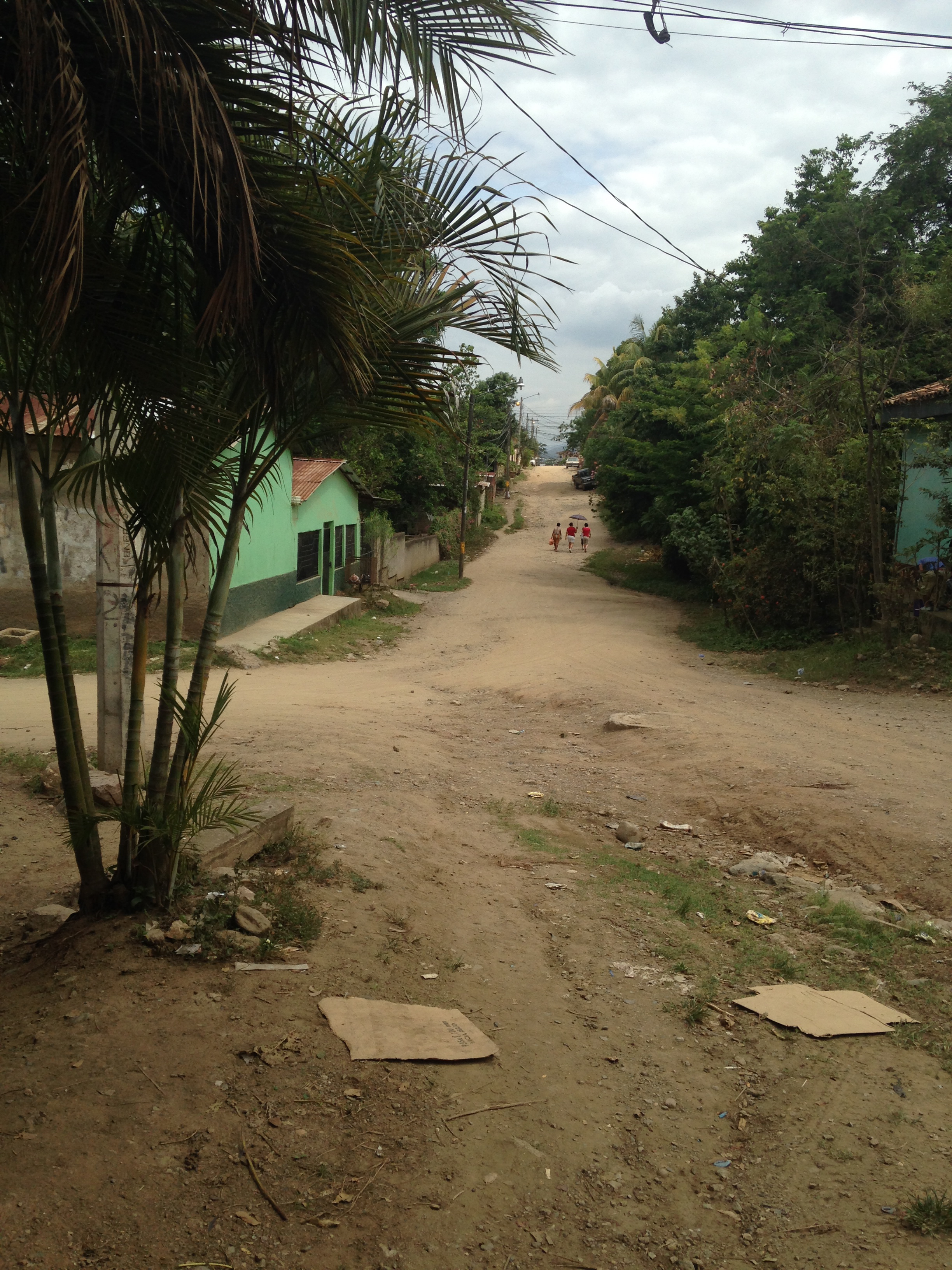
This is the street in front of our house, or really any house in our immediate neighborhood. Occasionally there are sidewalks, but these are narrow and often change levels or are crowded with goods or people, and it can be easier just to ignore the honking and hooting and dodge the cars and tuk-tuks and walk in the street. The houses and buildings tend toward cement bodies, tin roofs, and some disrepair, are surrounded by a cement wall or wrought iron fence, with a crowded clothesline and plastic chairs visible. A family member rests on a stoop or leans in the doorway. The wealthier homes are painted. The Small House is a neon green; others are tri-color. Our street – and did I mention there are few street names? – is a blend of homes and homes + pulperias (those little stores, remember?). Trees, shrubs, weeds, dust abound.

Depending on the heat, it’s about a 7-10 minute stroll to the town center, and the little stores rapidly multiply and now sell everything from used clothing, car parts, cell phones, tile and toilets, and school uniforms. With few exceptions, all are tiny and crammed with goods. Along the way is also Dentista Hernandez, a large smiling mouth painted on the wall, and at least one clínica. Because of the lack of street names and obvious landmarks, town center serves as my and Vee’s home base for exploration. The center is crammed with stores and more food vendors, including freestanding carts and tables with portable gas ranges in the park. This is where the bank (armed guard included) and mattress vendor are located. The square is always crowded, or maybe it just feels that way because of the vehicles and heat and attention.

On the topic of attention, yes, the stereotype is accurate. Men, all men under 70, little boys, turn, leer, and make greetings or comments, sometimes Spanish (qué bonita), sometimes English (I love you), to the female volunteers. They lean from tuk-tuks, cars, and doorways. They honk. And if you’re in an eatery, they might just sit at a table and stare. For the most part, except for that last example, and depending on the location, it feels harmless and slips immediately from my mind, but, I have to wonder, to what end do they do this? I suspect that if these men did a scientific analysis of their approach, they’d learn it had at least a 90% failure rate. Don’t most, if not all, of our interactions have an end goal? So what is theirs? I’ve read that I should consider it a compliment, and I can temporarily see through those lenses, but the commentary certainly is uninspired (Well, there was the tuk-tuk driver that called our volunteer coordinator “Sunshine of my heart.”). Maybe I will figure this out, if there is anything to figure, by the end of the trip. Please, if you have the answer, don’t tell me. Not to say that all men are like this, and those that know we are volunteers tend to be respectful.

The women, on the other hand, are much easier to relax with. In the States I tend to do the where do I put my eyes thing when I pass by someone. Usually the other person is doing the same, which is really silly, because why are we pretending the other person doesn’t exist in this temporarily shared space? Anyway, I tend to consciously make eye contact and smile at the women, and kids, and they usually give a genuine smile in return.

Skinny mutt dogs, the females with well-worn nipples, roam freely. And while they are used as guard dogs and are probably fierce when at home, still, I just see semi-starved little animals with dopey happy expressions on their faces. Scrawny chickens poke around the side streets. Lizards dart everywhere. Oh, and yesterday we had a spider about the size of my hand in the kitchen.

So that’s a snapshot of the town. I wish I knew more of it but wandering freely isn’t as possible as I was lead to believe, and the returning volunteers, i.e. suitable guides, are world-weary with the town and its offerings. In the meantime Vee and I poke around, buying groceries, school appropriate clothing, or just walking, expanding our borders where possible. But I am patient, and the lack of freedom forces me to focus on class planning. Less than a week!

The other night we had baleadas. So fresh! so wonderful! so full of yum!

As ever,

theresa

P.S. If you zoom in on the figure to the right hand side of the first picture you’ll see a little girl on a scooter. She made sure I was watching as she took off down the rocky hill in front of our house. [Actually, the way the blog is formatted, you can’t zoom in, but trust me, she’s there. Still learning WordPress.]

My first attempts to communicate

I’m starting this entry at 6:50 p.m. CST but would rather be sleeping. It’s been an exhausting day. Morning sounds included dogs barking, roosters sounding their scratchy bugle, and a bird making a sort of slide whistle call. Tonight’s sounds include dogs barking, three wheeled tuk-tuks, crickets, and children. The electricity was out at 6:30 a.m.; now it’s on. The water was on, then off, then on, now off. The internet shows a preference for certain websites one moment, for others the next. I’ve tried to download WhatsApp all day, with no success. At least the gas stove works and we have several tambos (jugs) and a pila (outdoor cement tub) full of water.

The primary barrier in my attempts to learn Spanish has been shyness (not to mention a lack of encounters with native speakers). It’s too easy to avoid the potential embarrassment of mistakes, hence, my forcibly living in a country where I have no choice but to risk looks that say, “¿WTF are you talking about, gringa?” That was later in the day when I attempted to help my roommate and fellow old lady (32 29), Vee, find plantain chips at a pulperia (small market where you order what you want through a grate). Plantains = platanos. Chips = ?, but surely if I ask for “dried plantains” the appropriate message will come across. “¿Tiene platanos secas?” Ummm, nope! Cue: mini-flood of shame. (Turns out the word we needed was tajadas.) And now I wonder if my directness was rude. Also, there was the encounter at the (semi)super mercado, where you can buy laundry soap, soy milk, and stoves, in which the clerk questioned my purchase of brown rice—did I have a medical issue? Not that I understood her question, spoken or mimed, and that’s where Vee and I make a great pair. Despite her lack of Spanish speaking skills, she understands okay; flip it for me. Thanks to Vee’s translation, I could stand my ground and declare my preference for brown rice, despite having no medical reasons for needing it, and proudly make my purchase with crumpled lempiras. I think some school boys asked if I was a dog.

But those were the only real bruises, and minor at that, as Vee and I wandered from the Small House (for the introverted volunteers. There is a Big House for the extroverts.) to el centro for flip flops, a hat, and groceries. A man behind us in line at an eatery explained Vee’s order to the clerk. The clerk at the pulperia across the road from my house patiently repeated multiple times just how the eggs were priced (5 eggs for 15 lempiras ~ US$0.75), and a produce vendor made sure I understood that the avocado (aguacate) should be eaten mañana. A smile to a passing stranger usually garners a smile in return.

Ta ta,

theresa

P.S. And…the water’s back on.

P.P.S. The internet currently works in 5 minute increments only.

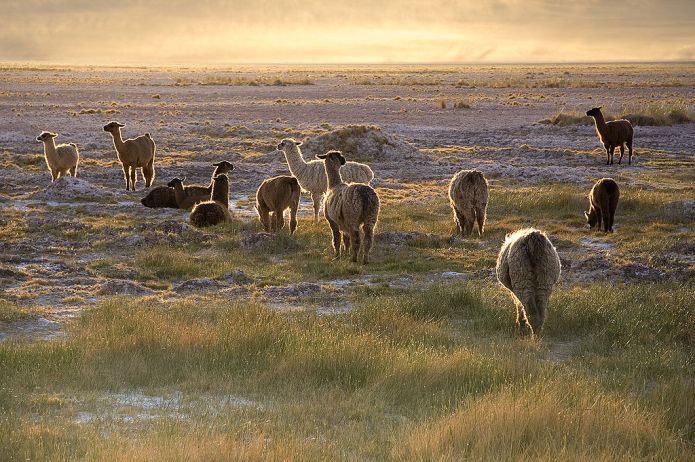
Picture of llamas at sunset.

I declare my intentions

Over the past several months, I’ve begun venturing into the unknown. I quit my paralegal job of nine years and agreed to teach Honduran seventh, eighth, and ninth graders English and Science for a year. In exchange I’ll get a roof over my head and lunch five days a week. I earned a Teaching English as a Foreign/Second Language certificate. I was inoculated against typhoid and tetanus. I bought a one-way ticket to Honduras, and I leave tomorrow. I have no source of income or idea of what I’ll do once the school year ends.

I am 34. Few, I think, would call me a risk taker, until now. Despite a fine arts degree in playwriting, I’ve mostly played it safe emotionally, chemically, sexually, and experientially. The rent is paid on time, and I’ve avoided getting lost in foreign countries. I re-read and re-read and re-read favorite books and trust in the loyalty of a plate of brownies. So, needless to say, I’ve lived well outside my comfort zone the past several months; I plan to continue doing so.

Sigh, that last sentence reeks of confidence, so let’s get real. While there is something to be said in praise of stability, if its root is fear, then I remain silent. I hate being afraid of failure, of not knowing, of falling on my ass, of external judgment. I hate being too afraid to discover what I love, including how to love myself. I want to change my life because I’m disgusted with the person I am. That person gets overly frustrated with origami, assumes that even her closest friends want to hurt her, and rarely commits, even to an opinion. I know the fence well.

Every now and then, perhaps on the seven year cycle, I realize it’s time to rip off the blankets. So what am I doing? I’m committing to goals that I, not anyone else, have decided are vital. I’m traveling to a country where a minority of the inhabitants speak English. I’m planning to learn as much Spanish as I can, after 20+ years of trying. I’m teaching, which was a dream in my early teens before I decided I couldn’t do it. I’m planning to write here at least once a week. I’m committing to now and not fretting about what will happen once this year is over. I’m doing my best to avoid Thoreau’s “life of quiet desperation.”

If I take too long of a look, I’m afraid about all of it, so I pick one fear: I want to be a good teacher for these kids! This journey toward selfhood is difficult and I’ve whined a lot. But, despite my fears and doubts and whining, something inside of me believes I’m up to this challenge, that even failure will be a success.

Undeniably so,

theresa

P.S. Llamas are not native to Honduras; I just like them.