I never knew just how much I rely on smiling in business exchanges. It happens less now, but I when I purchase something from the secret pulperia (a pulperia semi-hidden behind a wall) and the owner doesn’t smile, I wonder if I insulted her, was rude, or if my purchases were annoying. When she does smile, I walk down her steps content, even if she’s out of the tortillas or tajadas I requested. This type of interaction repeats everywhere: the produce stands, the school supply store, and the supermercado where the clerks tend to look rather bored, though that’s probably just their resting faces. The clerks and owners are polite, but there’s no smile to accompany their Buenas/Hola or Gracias and, despite repeated exposure, I replay the interaction, looking for my offense, searching for the smile.
My neutral face looks a little sad.
Articles, discussion threads, and studies about cultural differences often cite the “friendliness” or “politeness” or “smileyness” of the U.S. population (just google “culture” + “smiling”). Depending on the author, this is either praised as welcoming or disparaged as sign of the culture’s falsity. In my previous life, when I read these articles I would think of frozen-faced flight attendants as they waved me off the plane or the grumpy check-out person who definitely did not smile while helping me, the supposed British stiff upper lip or the rumor that Germans have no sense of humor … but I wouldn’t really understand what the author was talking about. People in the U.S. smile too much? Yes, some are bad at faking it, but what does “too much” mean? After all, I come from the land of smile therapy.
Now I think I understand, at least a little. As much as the disinterested facial expression causes the furrow between my brows to deepen into a canyon, why is it reasonable to expect a smile during our business transaction? I need something, s/he supplies it. Why does s/he need to appear thankful, and why do I either when it comes down to it? Does this transaction give either one of us significant pleasure? In the day-to-day, probably not. It’s about supply and demand. Let’s keep it honest and not muddle it with emotions. I find working in customer service, particularly in a store, face-to-face with customers, exhausting. I have to fake enthusiasm for a stranger and her/his purchases for 8 hours. Really, while I wish the customer no ill will, I rarely could care less. I’m there because I need money and the customer is there because s/he needs what I happen to be selling. I and the store I’m in are no more than a convenience. Yes, I’m happy to have a job and I will serve you with the courtesy you deserve as a human being, but why am I required to make it personal? Does it have something to do with the U.S. prioritizing industry and money over humanity? I’m sure there is a profit margin attached to a smile, or what appears as a smile, because a genuine smile can’t be imitated. (Accept no imitations, folks!)
I don’t really smile like this, but I look happy.
Despite my burgeoning awareness, I continue to seek out the smile. I frequent the same licuado stand because the young man always smiles during our exchanges. I doubt our secret pulperia has better prices than my usual produce stand, but the young girl who occasionally helps me can be so goofy, thus I buy bananas. In the States, I will return to a store if the clerks smile, even if the prices are slightly higher. That’s my reaction to an upturn of lips or baring of teeth, but what is the reaction of someone used to a less smiley culture? A culture that doesn’t equate smiling with competency and courtesy? (There have been reams written on this topic and my question doesn’t merit notice, so I’d rather ponder and navel gaze than research at the moment.) Conversely, I am slightly more comfortable with not accompanying my Gracias with a smile if I’m not feelin’ it. I’m less afraid that I will be found rude.
Besides, smiling causes wrinkles, and who wants that? Hmm…maybe cultures that smile less are secretly obsessed with appearing youthful. No, that’s the U.S. Never mind.
(No, I really don’t care about wrinkles. Well, not much, yet.)
Shake your ta-tas,
theresa
P.S. Having a mouth close up at the top of this post may not be the best decision.
P.P.S. Feeling a little bit of the goof today, in case you couldn’t tell. And while we’re on the topic of goof and smiling, Miranda rarely fails to evoke my genuine smile.
In the States I was always hungry for what I didn’t have, for who I wasn’t.
In Portland, a city of, among other people, fashionable, hip(ster) types, I always wanted. To have pretty clothes, a thin yet busty frame on which to hang those clothes, hair styled with the right amount of sass and nonchalance, make-up that accentuated the right features, with just a splash of whimsy, a shiny computer, a shiny bike, and eclectic, comfortable, and colorful home decor. An attitude of You Wish You Were Me. Because this, with my tunnel vision, is what I saw everywhere, in walking down the street, or biking to work, or going to the grocery store, or sitting in the lobby of a theatre. Even at the library I would see something I longed for, perhaps previously unknown. I lived in a very trendy part of town. A short walk supplied a day’s worth of ego crushing eye candy, sometimes enough to send me back to bed, burrowing beneath the sheets, simultaneously wishing to be and live in pretty and wishing it not to matter. I pinched my excess flesh in the mirror. I sighed at the sight of my 4 work outfits. I drooled at Modcloth and friends on Facebook, among too many others.
[I feel I should mention that it was my choice to live without much of the means to my desired ends. I worked part-time for 7 years so that I could pursue creative fantasies that paid nil. After awhile I grew resentful that I had to choose. And ashamed. Although, even if I did have the money, I wouldn’t have the skill to put together all the pieces of the person I wanted to look like or the world I wanted to see.]
Of course, I would also see people who had little, some by choice and others not, and would try to use those images to counterbalance the ache. Isn’t that what you’re supposed to do when focussing on the superficial?
Here, I’m not bombarded with these images. Being thin doesn’t seem to be fetishized, nor starving yourself (I happily accept your extra plantains.), and while the women may dress well, they’re rarely fashions I would want. Make-up uncommon on faces I see daily. Fancy computers non-existent. Bikes functional, not fashionable. Furniture plastic chairs. Houses concrete blocks. I look in the mirror to balance my pig tails, check for zits, and seldom else. Sure, some of the co-volunteers are my thin ideal and all are more fashionable than I, but I don’t think much about it. I have no one to impress. I want less, although if that’s due to lack of reminders or just exhaustion, I don’t know.
One day I will return to the States, to the land of desire and want and don’t haves and shoulds, and the hungry gremlins will return, because they’re still there. I do want pretty dresses, I still want to know how to wear make-up on sparkly occasions, I want to know how to style my hair, I want a new computer. I want pretty. I like shiny objects. It’s not that I’ve figured out what’s important—I know the important—only suppressed these desires. I don’t look forward to the want, the hunger, the sighs. Want wastes so much energy and what I want are unnecessaries.
Or are they? Is there anything wrong with wanting pretty? Or is the wrong in that it means so much?
Briefly,
theresa
P.S. This is only the tip of my complicated thoughts on this topic. No doubt I will revisit. Stay tuned!
Joe, along with six other of my seventh graders, has a two-week old behavior plan. At the end of each day I complete a sheet outlining his homework, assessing his behavior on a scale of 1 to 10, and providing any explanatory notes on behavior, either positive or negative, from a stock collection of phrases translated for me. A parent is supposed to review and sign the sheet everyday. Of all my kids, Joe is the most challenging. He talks almost incessantly and flings rubber bands across the room. He and another boy make porno-quality moaning sounds when my back is turned. Joe has massive goof potential and speaks to me in a loud silly voice and echoes me when I say “thank you” to him or one of the other students. His hair is light brown and styled with gel, he has long eyelashes, and like almost all the other boys at school, he is obsessed with football. He rarely does his homework. If I chastise him about anything he claims that I’m treating him unfairly because he’s a boy. He loves girls and has a good imagination. His attention span is fleeting. I like Joe quite a lot.
Many of my kids have stories of poverty, abuse, and violence. I don’t know if there’s a story behind Joe’s behavior. He’s known as being particularly problematic for all his teachers. At the recent parent meeting, which included the parents of the other students on behavior schedules, his dad (or uncle? This was never clear.) gave a bit of a speech about how tough things were at home. His parents are divorced. Joe throws school notes away or stuffs them under the seat of his busito.
My seventh graders remain a troublesome class, but (and because) I’ve been reluctant to impose punitive measures, probably because they weren’t necessary for me. I don’t have any stories of talking back to teachers or cutting class (The one class I did skip was on my 18th birthday and approved by my teacher, so that doesn’t really count.) or sneaking a smoke or drink in the bathroom. I took notes, raised my hand, did my work. I wanted to succeed and understood that I would have to do the work for this to happen. So I keep thinking that my kids will have the same understanding and that if my lessons are creative and interesting enough, I will tap into their latent desire to speak better English or discover the origins of the universe rather than gossip with each other and style their hair. My co-volunteers, more daring and rebellious, understand the kids’ perspective much better than I. They all have encouraged me to put names on the board, give detentions, because actions have consequences and the kids have to learn that. I know this is right, but it’s just so…negative. And these kids often get a lot of that negativity at home because yelling and hitting aren’t taboo here. Some parents tell us to smack their children if they’re acting up. I like giving out stickers and saying “thank you” and making people happy. I dread conflict; it makes me nauseous. I have too much self-doubt to hand out detentions. What if I’m being too hard? What if I punish the wrong kid? And what if they get mad enough that they stop talking to me and become even more disruptive? What if I’m wrong or unfair?
What finally pushed me onto Team Detention was someone pointing out that my reluctance was an unwillingness (my word) to work within the culture. The kids are used to the negative reinforcement approach from their Honduran teachers and parents. It’s what they know and expect; it’s their school culture. One of my TEFL books noted that it would be necessary to learn how to work within my students’ culture. The example it cited was Chinese students’ discomfort with volunteering answers and calling attention to themselves. They were used to attending lectures and taking notes. The teacher in this situation compromised her cultural expectations by letting the students compare answers in groups first and then calling on a group representative to give an answer. While all the other advice I was given on the issue was wonderful, citing my cultural inflexibility helped the most.
Not that it has been easy summoning the God of Names and Tallies on the Board for assistance. Every name earns a “Whyyy, Miss?” whine and a “Why aren’t you writing her/his name down?” and, if it’s Joe, desk banging on the floor. The students continually tattle on whose name belongs on the board because of something I didn’t see. I prefer the school of self-responsibility, but they also don’t understand that and, I admit, it isn’t much supported by the school, where kids throw their food wrappers on the ground for the cleaners to sweep up, ruin school property, and are promoted, even if their grades are poor. Obviously, they aren’t ready yet. Maybe we can get there.
In the meantime, while tallies have invoked more quiet, they have also invoked glares and whines, and my poor lonely heart wavers. I love making people happy, I want my kids to have fun, and, despite my protestations of not needing to be liked, I do want to be liked. How could I not when I see the other teachers getting breakfast and stickers and candy and hugs and devoted affection from their kids, while mine are generally too cool for that sort of thing, and I have masses of second guesses and continual longing for reassurance that this is a battle that I am qualified to slog through? The logical part of my mind knows that my lessons, at least for English, are interesting, that I’m approaching everything with compassion, and that tough love really is necessary. I also know that my kids like me. I do get hugs, smiles, and “Goodbye, Miss” at the end of the day. But…. There’s always that but, that nasty little whispering earworm.
Back to Joe. Tuesday, I made tallies and Joe collected the unlucky three. Also, some girls left class without permission to get in the recreo snack line early. That earned them detention, too, and some pretty impressive yelling (thank you, vocal training), which two girls didn’t much care about. (One girl, perhaps my sweetest, Yu, left early for the snack line but without my observing; she gave herself detention. I wanted to waive it just for her honesty.) Joe fumed and yelled about unfairness. He wrote that he was in detention because I favored the girls and that he wouldn’t be doing this again. We sat through detention. Another student apologized. We parted ways. I felt exasperatedly invigorated.
Seventh grade class doesn’t much improve, but Joe and I finally connect on Thursday. That afternoon, the kids let me know they are having no more of this sitting quietly for taking notes nonsense (and in retrospect they were right to disagree) and I divvy them into groups for some World’s Longest Sentence competitions. Joe refuses to join a group and asks to sit where he is, in a little desk island in the middle of the classroom (that day’s punitive measure). I reluctantly agree, but only if he practices Subject + Verb + Object sentences. A deal is struck. I circle the room, inspecting sentence competitions. I return to Joe and his sentences. They are perfect, even complex. The best sentences I’ve seen from him, from almost anyone. He names the S, V, and O. I ask for more, circle the class, and return to more beautiful sentences. I give him stars, pats on the back, and praise. A lot of praise. I say he can write more or just sit quietly. He chooses the sitting quietly. His behavior report says 6/10 that day, his highest score yet.
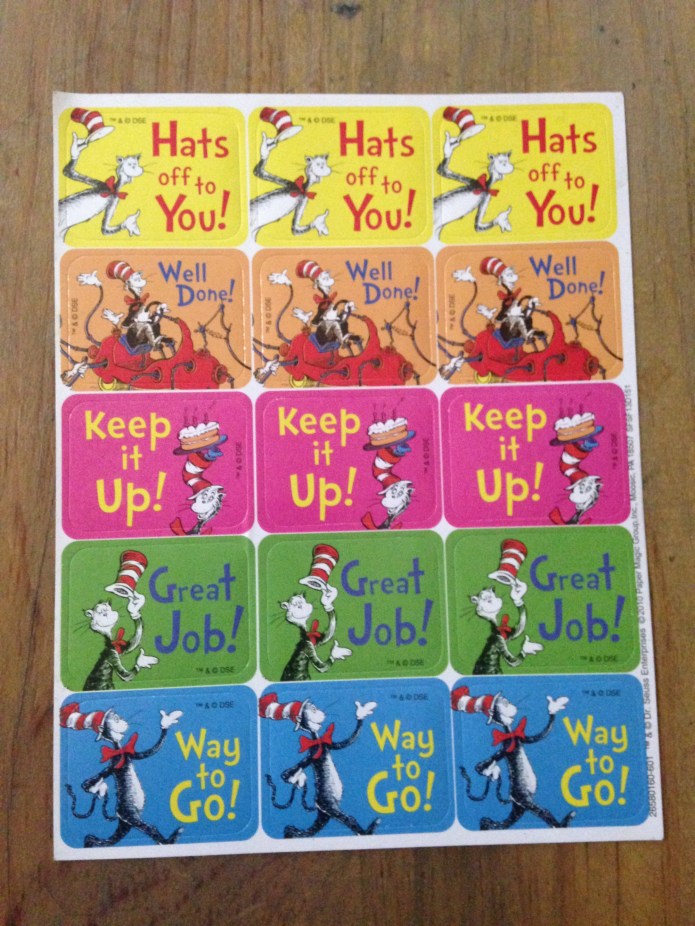
Friday is a short day for us. I have seventh grade for only two periods and one of them is filled with an assembly. The class works outside in the afternoon on a mystery game. Joe is not only the first one done with the initial part of the game—drawing a picture and interviewing his classmates—but he writes up his accusation and 14 present progressive sentences regarding what the suspects were doing when Miss Theresa’s cows were stolen, and is the only one to finish. His report that day is 8/10, a Dr. Seuss sticker, and some garbled Spanish comment in praise of his participation. After school, I want to tell the world about his work, host a parade in his honor; I have to confine myself to a few fellow teachers.
My best teaching moments so far are these, when I’m able to meet with my students one-on-one and give them the attention they crave. At 14 students, my class is small, but they are all needy little buggers and the classroom is tiny and cramped and so loud because there are no full walls in this row of four classrooms. No wonder no one can focus. All of my troublesome kids love the spotlight of my attention. Unfortunately, one-on-one moments are rare unless I have an assistant or I’ve happened upon an activity that my kids will do independently for a whole minute before calling out, “Miss. Miss! MISS! MIIISSS!” They need more.
I have another story similar to Joe’s, a girl named Kim, who spent her time giggling and coloring and was too embarrassed to answer questions. Her friends would tell me she didn’t know English. But I had my doubts as to the veracity of this after our first written test when her mark was surprisingly good. It turns out, after separating her from her fellow colorer and having her mom review the behavior plans, that Kim has some of the best written work in the class; she’s started participating. She loves getting stickers and I love giving them to her.
Sometimes, no, often, what doesn’t work in class overwhelms me and I feel pretty hopeless. It’s these moments with Joe and Kim and Krissy and Fred and Antonio that keep me going. My kids drive me batshit crazy, I doubt daily that I’m going to survive the next eight months, and I wouldn’t exchange these moments of connection for anything.
Remember the guy that lead us from the bus to our hotel? Vee decides to hire him for a two hour horseback ride through the Ruins, another one of his businesses. Now, my guidebook said that we would be mobbed by men who would try to “sell us overpriced horseback rides,” and I don’t want to be a Naive White Person Who Gets Ripped Off. Plus, I distrust anyone who aggressively tries to sell me something, maybe because I’m so non-agressive or because I can’t think rationally under pressure. But I agree to go along in the spirit of adventure, and we pay half of the fee that night. To reassure myself that this isn’t stupid, I reason that the manager and our co-volunteers saw us with this guy, who I’ll call Mr. G, so it is unlikely that anything horrible will happen.
Let’s just say Mr. G gets a little creepy. We agree to meet at 9 a.m. When we go down for breakfast the next morning, he is in the lobby. After breakfast, we wander around the town. He appears by our side and asks if we need a tour. At 8:45, when we return to the hotel and are admiring the view from our floor, he appears behind us, indicating it’s time to go. If Vee had decided to back out of the trip then, I wouldn’t have minded. Instead, we shoo him away, brush our teeth, then meet him at the appointed time. Surprisingly, he doesn’t ask for the rest of his fee right away. He waits until we are in the crowded town square, a most awkward time to be waving around our lempiras. Since he can’t break our bills, he agrees to accept fifty lempiras until after the ride, though that doesn’t make sense, because our bills won’t get any smaller during the ride, it’s how I remember it. We walk past the edge of town, where the cobblestones turn to dust, and I feel very white and foolish and am being stared at by a truckful of people. We approach three horses tied to a fence. A man, who I assume owns the horses and is paid off by Mr. G, chooses two and helps us mount. My feet aren’t too snug in the stirrups. My rope reins are too short. Off we go.
The ride—except for the part where Mr. G whistles to make my horse go into a trot, which is rather uncomfortable if the stirrups are too long for your short legs, and, actually, to be honest, it’s uncomfortable when you haven’t ridden a horse for 20 years—is lovely. It’s along the Copán River, thick, wild, and brown from the storm the previous night. The path is mostly deserted, tree-lined, and muddy. We pass bare tomato fields, feed grass fields, and cows. Vee is ecstatic. She loves horses and breaks into a gallop, far from my slow mount, often. That’s probably the best part of doing an off the grid horse tour—no rules. At one point Mr. G waves me off my horse and races with Vee. He obviously loves horses. My guess is that that is what he’d rather be doing, instead of giving white people horseback rides and scrambling around to make a living. But that’s just a guess.
Mr. G’s English is good enough, but not overly so, and if I were a suspicious person, I’d wonder if that is intentional. It’s never clear where exactly the “tour” ends. Initially it sounded like a horse ride through the Ruins. Then it was unclear if we would even get to the Ruins or if he would just point us in the right direction. Maybe he needs to work on his prepositions of place. In the end, the tour stops awkwardly in a field by a gas station, about a hundred feet past a security check point, through which Vee galloped, wishing the guards a “Buenos días.” We dismount, I wash the smashed banana-covered interior of my bag, and we walk to the entrance to the park. I am eager to ditch Mr. G at this point. If he had his way, however, we would hire his brother as our guide through the Ruins. Or we would hire him to give us a tour of the town tomorrow. Instead, we pay him the remaining fee, he requests a tip, and our tip is so poor, in his opinion, that we never see him again. And that leads me into another topic.
I’m not sure which bothers me more, being taken advantage of or not knowing I’m being taken advantage of. Because I’m white, there is an expectation here that I’m rich. Comparatively, I am. Being (over)charged 20 lempiras (US$1) instead of 10 for a mototaxi ride has no real effect on my wallet. The expensive breakfast I ate Monday cost less than US$8. The extremely modest savings that have afforded me this volunteer opportunity and my travels are more than most Hondurans earn in three years. In the States, I have a smartphone, internet service, and live in a house (shared) with running water, electricity, a backyard, and a refrigerator full of food. Those things make me rich here, and I don’t imagine it would translate if I explained that in the States, I’m far from rich. I could never have a vacation comparable to Copán. I was without healthcare for several years until Obamacare passed. I do ride a bike for health and environmental reasons, but I really couldn’t afford a car. And let’s just say that most of my clothes are worn out enough that it’s no problem for the colors to be washed with the whites. None of that matters, though, because as little as I might think I have, the people here and in many places, including the States, have even less.
World economics are anything but fair. I have benefited from their poverty and exploitation, so why shouldn’t people here be tempted to overcharge me, and why should I mind? Is it that the perspective of myself as a walking wallet makes me question my responsibility toward the world, especially as a U.S. citizen? My country is rich in part because it exploits others. It allows its businesses to exploit others, or The Others, the brown people, if you will. If I were a better blogger I would cite articles and facts here (smallpox blankets, anyone?), but do I really need to? This statement should not be in question. (If you, dear reader, want some facts thrown at you, just let me know in a comment or email.) While I did earn the money that brought me here, and my work was good and honest, it isn’t completely clean. I know and I’m not clean. I’m trying to figure this out, right here, on this screen you’re reading. I understand, even appreciate, the motivation to look at me as a cash machine, and part of me doesn’t understand why I don’t tell them, the anonymous faceless “them” of the world, to take it all. No, that wouldn’t do anything, really. That’s not how a lasting change will occur, but it would be a temporary relief, a bandage over my guilt, a luxurious feeling that is pretty useless to anyone.
While I suspect I’m being overcharged in certain circumstances in Copán, the awareness doesn’t draw emotion until the other volunteers point it out. They mention how they call out the mototaxi drivers and fruit vendors on their “steep” pricing (in quotes because everything, unless it’s imported, is cheaper here and I find it difficult to call anything expensive). While I had noticed the higher prices, I attributed them to Copán’s higher cost of living. It was then I felt shame, not from paying higher prices, but being told I should be upset about it. So when I went to the fruit vendor, I named my price, a lower one than what I had previously been charged, and she accepted. What did that save me? US$0.25. Maybe being overcharged doesn’t bother me. Maybe it’s being caught acting like an unsavvy traveler, which I am, but which, in actuality, in my true self, I don’t much care about. Not today, anyway.
Okay, here is the one overpricing that did upset me: we were told our room was US$11 each per night. Vee and I paid this the first two nights. Then, on the last night, I paid my share and the attendant, the mother of the manager, I presume, said we owed only US$1 more, not US$11 more. Apparently we had been charged almost double the standard rate our first two nights. That seems a bit egregious.
Also, I will say that being taken advantage of in my temporary home town does bother me because all the residents know that white people here are either Mormons or volunteers…and we’re obviously not Mormons!
And now I leave you with these deep thoughts. I’m sure you thought vacation time meant lighthearted, but that is just not my style. More Copan—the Ruins, the parade, the hot springs!—soon,
The schoolyard during recess or lunch on a Friday, or Color Day, when students can wear whatever they want after paying a small fee (fundraising), is a wonderful place. Instead of the standard khaki shirts and forest green pants/skirts, the yard is filled with splashes of every color and modern street clothing style imaginable. Small people-in-progress chase each other, play football, dodge footballs, walk arm in arm, eat, and chat with the volunteers. The faces are smiling and laughing and crying and open, open and waiting to be filled with their futures. The scene is probably interchangeable with any playground anywhere. So much joy and hope, but this week the scene became tinged with a bit of gray.
I’m one of the most open minded people I know. Passing judgment on anyone other than myself simply isn’t my style. (Visit my familiarity with the fence.) While the sexism of the community bothers me quite a bit, it’s cultural and how the people are raised. I’m here to teach English, not thrust my point of view upon my neighbors, though my belief in the equality of all persons will inevitably come across. So I’m troubled, as a self-proclaimed non-judgmentalist, that when I look at these boys running in the schoolyard, I connect them with the men whistling or making kissing sounds when I pass by or to the shopkeeper who pointedly ignored me before overcharging me for an avocado. Is it inevitable that these lovely young boys in the schoolyard, including my inquisitive geeky boys, will one day turn into sexist assholes? (Look! I just passed judgment.) My judgment gives me saddies, a slight despair, because those men on the corners could be intelligent, capable human beings, but the second they purse their lips or slide their eyes my way, I put them in a box and shelve that box in the dump. I understand but don’t like my all-or-nothing thinking, this dismissal of an entire person based upon this one characteristic, although it is rather revealing of his view of the other gender. It also gives me saddies that I purposely avoid looking at any male over the age of 13, due to this very characteristic. But I’d rather not appear to be inviting those much too young boys who leered at me when I went to make copies the other day; instead, I pointedly watched the Discovery Channel episode playing on the television. I don’t know how the male Honduran teachers would have reacted, but Friday, when my 7th grade boys whistled from the classroom window at a group of girls in the yard, I sternly told them to move away from the window and join the class. Maybe the male teachers would have laughed, or maybe they would have done the same as me. All I know is what I will not accept.
My gray visions also include the girls. Marriage happens early here, babies happen early, and on Color Day, some of these girls are dressed a wee bit provocatively. I remind myself that many of the parents of the students want different futures for their daughters. CBS is a private school. While even public school charges a fee, these parents have chosen to pay a higher fee in hopes that their daughters will learn enough English to get into a good bilingual high school and that their bilingualism will lead to better job opportunities or college. Motherhood is wonderful…when it is a choice. I despair the lack of choice.
I tell myself that nothing for these children, for any children, is inevitable. Given that the kids at CBS are exposed to teachers from other cultures and with other points of view, their views of women might be more egalitarian.
These thoughts probably aren’t worth spending much energy on, but I do, because I’m thinking of creating lesson plans that either subtly or not-so-subtly address my concerns, those noted above and a few others, like homosexuality, as other teachers have done. Maybe I’ll even do one about vegetarianism. What bothers me is that my concerns are indicative of my privileged US American point of view. Despite the rampant sexism and anti-open sexuality of US society, I still am allowed and can find an environment to feel and think the way I do, yet it is not my place nor my way to disregard or disrespect the worldview of others. So I am conflicted that I struggle to practice my non-judgment here, though as a female, how could I not struggle?
Those are theresa’s Profound Thoughts of the Week.
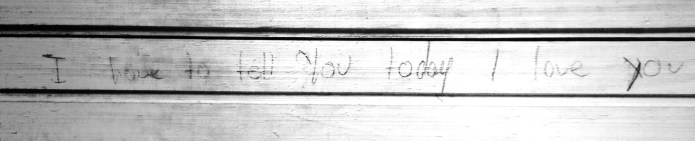
When I began exploring new careers, I wanted a job that actually made people happy, for once. I’ve somehow chosen the opposite. Or it’s just me. Let’s just say this week was harder than the previous at school, with multiple headaches, and it was all I could do not to bawl when my last class on Friday was dismissed. I put my head down on the desk and listened to music very loudly instead. All but two of the 8th graders failed their science test and got a stern talking to. (They’ll also get a re-try, which I’ll offer for most of my tests.) I suspect two of my 9th graders cheated. And the 7th graders, well, I’m trying. There were some positives, like the day the 7th grade boys worked hard on a project together, with almost no supervision, and one of my most troublesome girls actually listened to something I said. And there was the discovery of the above graffiti in the bathroom.
I feel caught between worlds at the moment. I don’t belong here and I don’t belong there. I don’t belong anywhere. But as long as I’m here, I might as well eat a bunch of delicious lychee/litchi fruit.
My home for the year is a small town of about 40,000 people, according to a fellow volunteer. Located 24km/14.9mi/a 1 hour bus ride away is the nearest and second largest city in Honduras, San Pedro Sula.
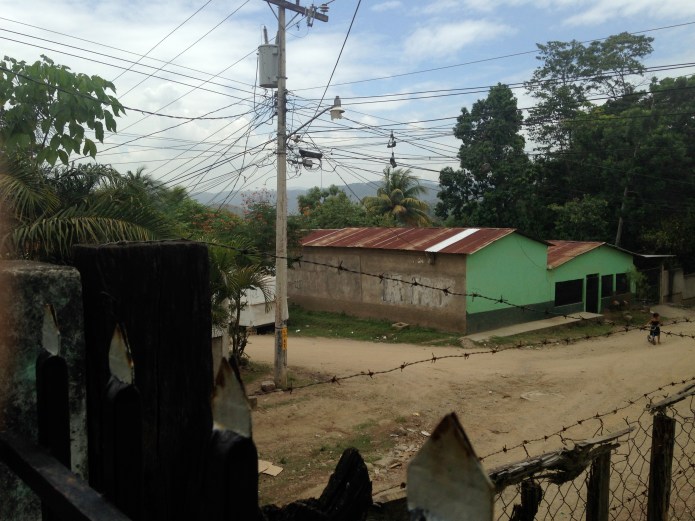
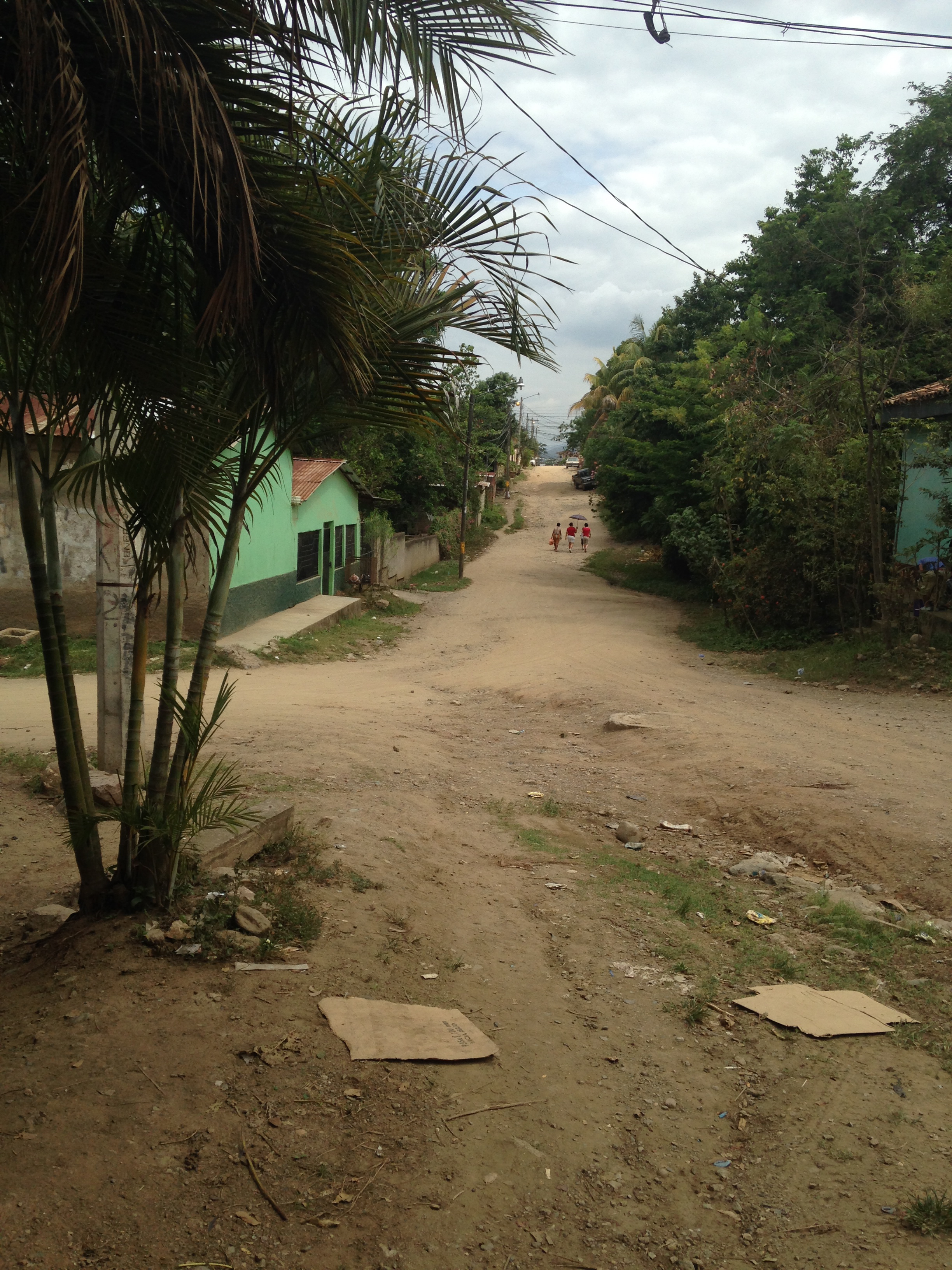
This is the street in front of our house, or really any house in our immediate neighborhood. Occasionally there are sidewalks, but these are narrow and often change levels or are crowded with goods or people, and it can be easier just to ignore the honking and hooting and dodge the cars and tuk-tuks and walk in the street. The houses and buildings tend toward cement bodies, tin roofs, and some disrepair, are surrounded by a cement wall or wrought iron fence, with a crowded clothesline and plastic chairs visible. A family member rests on a stoop or leans in the doorway. The wealthier homes are painted. The Small House is a neon green; others are tri-color. Our street – and did I mention there are few street names? – is a blend of homes and homes + pulperias (those little stores, remember?). Trees, shrubs, weeds, dust abound.
Depending on the heat, it’s about a 7-10 minute stroll to the town center, and the little stores rapidly multiply and now sell everything from used clothing, car parts, cell phones, tile and toilets, and school uniforms. With few exceptions, all are tiny and crammed with goods. Along the way is also Dentista Hernandez, a large smiling mouth painted on the wall, and at least one clínica. Because of the lack of street names and obvious landmarks, town center serves as my and Vee’s home base for exploration. The center is crammed with stores and more food vendors, including freestanding carts and tables with portable gas ranges in the park. This is where the bank (armed guard included) and mattress vendor are located. The square is always crowded, or maybe it just feels that way because of the vehicles and heat and attention.
On the topic of attention, yes, the stereotype is accurate. Men, all men under 70, little boys, turn, leer, and make greetings or comments, sometimes Spanish (qué bonita), sometimes English (I love you), to the female volunteers. They lean from tuk-tuks, cars, and doorways. They honk. And if you’re in an eatery, they might just sit at a table and stare. For the most part, except for that last example, and depending on the location, it feels harmless and slips immediately from my mind, but, I have to wonder, to what end do they do this? I suspect that if these men did a scientific analysis of their approach, they’d learn it had at least a 90% failure rate. Don’t most, if not all, of our interactions have an end goal? So what is theirs? I’ve read that I should consider it a compliment, and I can temporarily see through those lenses, but the commentary certainly is uninspired (Well, there was the tuk-tuk driver that called our volunteer coordinator “Sunshine of my heart.”). Maybe I will figure this out, if there is anything to figure, by the end of the trip. Please, if you have the answer, don’t tell me. Not to say that all men are like this, and those that know we are volunteers tend to be respectful.
The women, on the other hand, are much easier to relax with. In the States I tend to do the where do I put my eyes thing when I pass by someone. Usually the other person is doing the same, which is really silly, because why are we pretending the other person doesn’t exist in this temporarily shared space? Anyway, I tend to consciously make eye contact and smile at the women, and kids, and they usually give a genuine smile in return.
Skinny mutt dogs, the females with well-worn nipples, roam freely. And while they are used as guard dogs and are probably fierce when at home, still, I just see semi-starved little animals with dopey happy expressions on their faces. Scrawny chickens poke around the side streets. Lizards dart everywhere. Oh, and yesterday we had a spider about the size of my hand in the kitchen.
So that’s a snapshot of the town. I wish I knew more of it but wandering freely isn’t as possible as I was lead to believe, and the returning volunteers, i.e. suitable guides, are world-weary with the town and its offerings. In the meantime Vee and I poke around, buying groceries, school appropriate clothing, or just walking, expanding our borders where possible. But I am patient, and the lack of freedom forces me to focus on class planning. Less than a week!
The other night we had baleadas. So fresh! so wonderful! so full of yum!
As ever,
theresa
P.S. If you zoom in on the figure to the right hand side of the first picture you’ll see a little girl on a scooter. She made sure I was watching as she took off down the rocky hill in front of our house. [Actually, the way the blog is formatted, you can’t zoom in, but trust me, she’s there. Still learning WordPress.]
I’m starting this entry at 6:50 p.m. CST but would rather be sleeping. It’s been an exhausting day. Morning sounds included dogs barking, roosters sounding their scratchy bugle, and a bird making a sort of slide whistle call. Tonight’s sounds include dogs barking, three wheeled tuk-tuks, crickets, and children. The electricity was out at 6:30 a.m.; now it’s on. The water was on, then off, then on, now off. The internet shows a preference for certain websites one moment, for others the next. I’ve tried to download WhatsApp all day, with no success. At least the gas stove works and we have several tambos (jugs) and a pila (outdoor cement tub) full of water.
The primary barrier in my attempts to learn Spanish has been shyness (not to mention a lack of encounters with native speakers). It’s too easy to avoid the potential embarrassment of mistakes, hence, my forcibly living in a country where I have no choice but to risk looks that say, “¿WTF are you talking about, gringa?” That was later in the day when I attempted to help my roommate and fellow old lady (32 29), Vee, find plantain chips at a pulperia (small market where you order what you want through a grate). Plantains = platanos. Chips = ?, but surely if I ask for “dried plantains” the appropriate message will come across. “¿Tiene platanos secas?” Ummm, nope! Cue: mini-flood of shame. (Turns out the word we needed was tajadas.) And now I wonder if my directness was rude. Also, there was the encounter at the (semi)super mercado, where you can buy laundry soap, soy milk, and stoves, in which the clerk questioned my purchase of brown rice—did I have a medical issue? Not that I understood her question, spoken or mimed, and that’s where Vee and I make a great pair. Despite her lack of Spanish speaking skills, she understands okay; flip it for me. Thanks to Vee’s translation, I could stand my ground and declare my preference for brown rice, despite having no medical reasons for needing it, and proudly make my purchase with crumpled lempiras. I think some school boys asked if I was a dog.
But those were the only real bruises, and minor at that, as Vee and I wandered from the Small House (for the introverted volunteers. There is a Big House for the extroverts.) to el centro for flip flops, a hat, and groceries. A man behind us in line at an eatery explained Vee’s order to the clerk. The clerk at the pulperia across the road from my house patiently repeated multiple times just how the eggs were priced (5 eggs for 15 lempiras ~ US$0.75), and a produce vendor made sure I understood that the avocado (aguacate) should be eaten mañana. A smile to a passing stranger usually garners a smile in return.
Ta ta,
theresa
P.S. And…the water’s back on.
P.P.S. The internet currently works in 5 minute increments only.






 Asteroid Pen