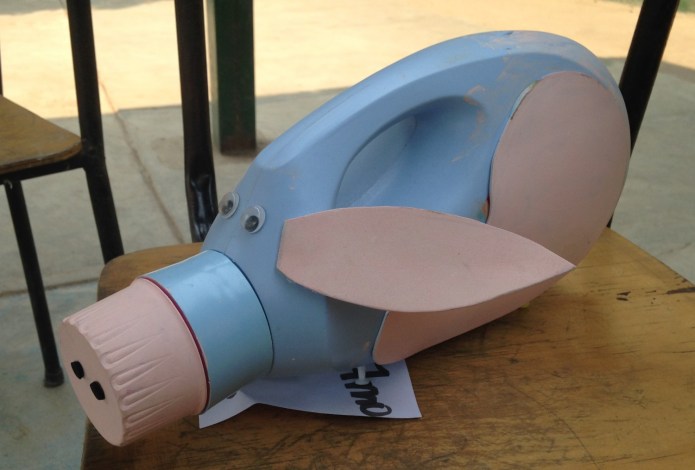
pig made from detergent bottle

Making do

The busito that takes us to school is gray and battered, like a package that’s fallen off a truck and been kicked around several times. I identify its approach in the morning by its squeaks and rattles. There’s no speedometer, the front passenger door opens from only the inside, and the rear sliding door has always been tricky, requiring a strong arm. On Monday a volunteer’s arm was a little too strong and pulled the door completely off the track. The driver spent a few minutes attempting to slide it back into the track, then left the door at the pulperia across the road. The door was reattached on that afternoon, but has since disappeared. I don’t mind; the additional breeze is nice. The rainy season is long past.

As we trundled off to school, I couldn’t help thinking that if this had happened in the States, we would still be at the small house, waiting for a new van to pick us up. And rightfully so, I’m sure. Part of me was worried about a sudden turn that could push me off my seat and spill me into the road, or a T-bone collision on my side of the van. But we had to get to school and the busito still worked, so, doorless, off we went. Practical.

Almost everything here is cheaply and poorly made, as if this town is supplied solely by Walmart. Bandages don’t adhere. Paint peels quickly. My earbuds broke almost immediately and are held together with masking tape. Kay’s new coffee thermos cracked on the side the next day and it no longer pours well. None of the replacement bulbs for my Christmas lights worked. Our washing machine needs a lot of assistance to get anything clean. But the broken isn’t thrown away. People use wire, twist ties, and plastic connectors to hold the easily broken but ubiquitous plastic chairs together. The cheap and now broken fans are repaired. Empty paint cans are used to scoop water for flushing the toilets. Old pants are used as wash rags and fences for hanging clothes on to dry. Plastic bottles, cans, rocks, and even unripe mangoes double as footballs.

I am not very handy, except with duct tape, my go-to solution for just about everything (tape, albeit packing, currently holds our toilet seat together). While DIY and making and crafting has resurged in the US, still the prevailing attitude is buy and replace. Shop and Home Economics aren’t offered much in school anymore, as the push is for academics, not life skills, unless a child is in a special education program. College is the goal, not trades. Rather than a holistic view that values and incorporates academic and life skills, the sides are split and actively—and sanctimoniously—battling each other.

Now, pause that thought. Biking. There are two or three bike parts and repair shops in the less than half mile walk to the town center. Many people, mostly men, bike. A bike can be a family vehicle, with a father pedaling, a mother sitting on the center bar holding a child, with maybe another child sitting on the handlebars. One of my students once transported himself and three others from school to the nearby football stadium on his youth-sized mountain bike, and going at a rather rapid pace, I might add. Bikes carry bundles of firewood and supplies. Vendors pedal and peddle newspapers, pastries and coconut bread, and hot food from plastic coolers.

My home is in a place that desperately wants to be the biking hub of the US. Within a one mile radius are at least three, maybe more, bike repair shops. I bike, my partner bikes, and there is traffic during rush hour and I get bike road rage. If I want, I can order pizza or soup or sandwiches to be delivered by bike. I can move house by bike. New Seasons, the local grocery store chain, included bike parking in its promo campaign for the store opened in our neighborhood. You can go on a pub pedal and ride while drinking beer on a nifty and ridiculous contraption to all the nearby bars, meanwhile drunkenly harassing passersby. Biking is THE THING. Portland is GREEN. Cars vs. Bikes…Who Will Be Victorious?

I started my life as a full-time biker and special waterproof clothing wearer eight years ago when I transitioned from full-time to part-time work and could no longer afford a bus pass. And I had been taking the bus because driving makes me nervous, plus, yes, it is better for the environment. What would generate a low internal boil was when people ascribed moral qualities to me for biking. I’d get comments, particularly in winter and on rainy days, about how good and admirable I was for biking in the weather and how the commenter could never do that. Well, sure, the commenter could if her income was low enough. If the alternative on those bad weather days was a nausea and headache inducing hourlong bus ride. I don’t deny I’ve got a chip on my shoulder about the topic because, honestly, biking in the rain, when condensation builds up in my jacket and my shoes get soaked, sucks. Biking in freezing weather while wearing three pairs of gloves that still aren’t enough to prevent my fingers from going numb is unpleasant. Biking to the point that I have soft tissue (aka genital) pain that several different saddle styles hasn’t helped, leading to significantly decreased sexual pleasure, sucks. Please, don’t moralize at me. I do love having exercise built into my life and the wind-through-the-helmet feeling. But, sometimes, a car would be nice.

I do wish more people would bike in the US because it’s better for the environment. It’s also good exercise, if that’s your thing, and, really, I’m not a gym person. But I don’t appreciate the moralizing, and ego, and, again, sanctimonious attitude from other bikers. I’m not a better person. I don’t like the price markup that comes with bike appropriate gear, like waterproof clothing or bags. The idea of moving house by bike is ridiculous and causes more pollution as the crowd of bikes blocks car traffic. And can my fellow bikers please be honest about how annoying wet shoes and socks are?

Ultimately, the point of biking, just like walking or cars, is to get from here to there. The bikes here aren’t fancy or shiny (that’d be impossible in this dust), but they get the job done. Point A to B. If given the choice, I’ve gotta believe that someone would much rather drive than pedal up that steep hill while carrying firewood on a road that is so rutted and rocky as to bump and bruise anyone’s genitalia. I’m also sure that someone would much rather afford a better built fan in the first place than having to fix it when it breaks down the next day.

Honduras is not an environmentally conscious country. Trash is thrown from the window of a bus and garbage is burned and people wash their clothes, cars, and animals in the river. The choices made to repair and bike are usually, I’m assuming, financial ones. But I appreciate being amidst the attitude of why we repair and bike in the first place—it’s necessary and the best choice. Ten people ride in the bed of a truck because it’s the best way to get somewhere. It’s certainly not safe, but it is practical. This is a place where people make do. They have to. Some people in the US who don’t have to are relearning to, and that’s terrific, blah blah, but along with that comes an attitude and judgment toward those who don’t. The reaction is extreme. I suppose if that gets others to change, great, but in the meantime, I appreciate this aspect of life in the judgment free zone. Don’t talk, just do.

Sweatily,

theresa

P.S. Another project from Earth Day, this time by seventh grader Isabel.

Basket made from newspaper

The Joy of Solitude

Friday, May Day, was a fantastic day because I was alone, without threat of undesired company, all day long. That hasn’t happened since winter break. Vee and another housemate left town for the long weekend, and our male housemate is rarely ever here, leaving me and Kay, my fellow uberintrovert, to ourselves. I knew Kay was here by only the occasional kitchen sounds or slamming of the bathroom door.

That morning, I awoke. There was no one to comment on the minor drop in temperature the previous night that was “freezing.” The water flickered off and on. No one commented on a thwarted desire to shower or how she couldn’t focus or how odd it was that the men who arrived to weed the yard just hopped the fence and started working (but I did text The Boy about this). I wasn’t expected to react to the lack of bananas at the secret pulperia or expend energy on matters I didn’t care about. Ahhhh, relaxation. I read The Girl with the Dragon Tattoo trilogy, made and ate brownies, typed and thought and typed and thought on The Machine, researched end of year travel plans (swimming with sea turtles!), ate brownies, watched a movie, and discovered new music, including Mexican alternative pop. My only interactions were at an end-of-year dinner at Miss G’s house with the other volunteers and the Honduran teachers, the highlights of which were discussion of a volunteer’s 18 intestinal parasites and scheduling a future date with Kay to see the new Avengers. I wonder if I have parasites.

The pleasure of solitude comes from having control over my internal environment, interactions, and choices, to the maximum extent possible. It means cooking dinner uninterrupted, farting loudly when required, paging through a book for hours, and leaving the vocal cords and the Spoken Word Generation Neural Network (SWoGNN, pronounced “swhoa-gen”) unexercised. I can give everything I have to my own interests. The alternative is just too tiring, especially within a group of people whose needs, ideas, or modes of expression rarely coincide with my own. I’m unsure how to respond and resent that my interpretation of social convention requires that I do so for the sake of politeness. Some days I just grunt noncommittally.

Aside from my living situation, I get the impression that desire for solitude is not understood here. The room Vee and I share initially had three twin beds and we briefly had a third roommate, which for us was a bit much. But some families live in homes smaller than this room. Multiple generations live together. Families are large. Solitude requires space, which is a luxury, so the need might be somewhat culturally developed.

Being shy and self-concious, in addition to introverted, contributes to my frequent yearning for all extra people to be gone. These qualities, unfortunately, interfere with my ability to follow some Honduran customs. When entering a room, even if people are having a conversation or you’re late for a meeting, it is proper to say “Excuse me” or “Hello” or “Good afternoon,” to call attention to yourself beyond the physical interruption. If you pass by someone eating, even if it’s a stranger, it is proper to offer a “Buen provecho.” These courtesies are beyond me in any language. They require me to break the fourth wall and call attention to myself, assume that another cares to interact with me and cares about my existence, increase the risk that the person with whom I interact will want more, and risk rejection. My awkwardness has lead to unintended rudeness before. As a child, when I left a friend’s house I wouldn’t say “goodbye” to the family for the reasons listed above. So some families didn’t like me. I still have this problem, even with my family.

This seems to be a very outward and social culture: what happens to introverts and shy ones? Activities require so much more assertiveness and personal interaction here. To buy almost anything I have to tell the vendor what I want rather than grabbing it myself. Replacing the gas tank requires a visit, sometimes multiple, to the Tropigas shop. People don’t line up but push to the front. There are no street signs, so finding a new someone or something entails help from someone else. It all requires people, whereas I love the impersonality of the internet. The language barrier here makes all of this so much more challenging of course, but, even at home, I shy away from small stores, where the attention of the clerk is unavoidable.

The roommate will return Sunday, then it’s back to the stress of unwillingly lending brain space to another, but it won’t be long now before I’m back home, sharing my space willingly with my partner and a little less willingly with our three cats. And when even that is too much, retreating to my room for some quiet time.

Shake your ta tas,

theresa

P.S. Today’s picture is of the winning art project from the Earth Day competition. The lid removes so you can store tiny trinkets inside or your false teeth.

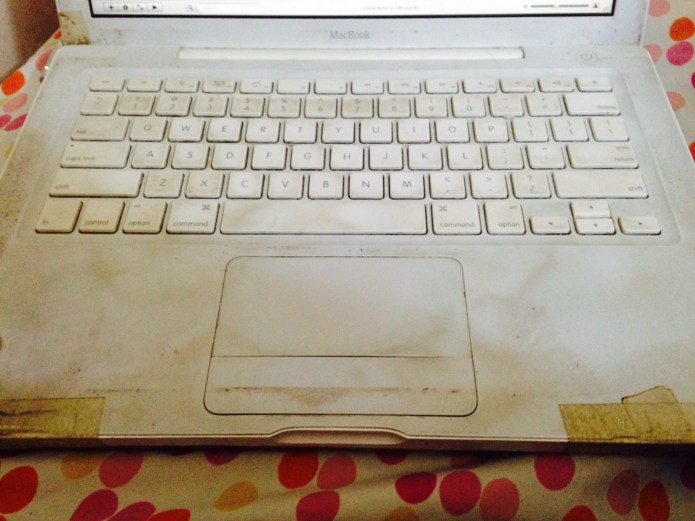
My gross keyboard

The Machine (2)

Read (1).

At eight hours, the screen darkens, my total clicks of the day flashes in neon-green, along with my day’s wages, at 2 cents per click. The supervisor stamps me out of the room and I collect my paycheck from the machine outside. The few friends I have envy this daily payment, but it’s only a reminder of my expendibility. Any day now, computers will be able to perform this job better and more quickly. I could arrive at my early am tomorrow to find that the bathrooms have been ripped out—because computers don’t shit—and the clocks taken down—because computers don’t care about smoke breaks. No notice or warning, and I would walk back down the stairs and stare into the rising sun, which I can’t see from The Room. I’d probably have to cover my eyes from all the light. And then

And then

Well, I’d have to look for something else, wouldn’t I? Not the easiest task for the immobiley inclined, especially when the buildings are so tall, with all those stairs to climb. Employment insurance for people in my inclination group is expensive as hell; I’d have to work double time to cover the premium. Company knows it’s just a matter of time before they’re paying for me to keep on my ass. The government requires it but the look the other way fee is cheaper. I pay it, buy a little dinner, and bank the rest.

I like (liked?) reading prediction novels, the old ones that guessed what life would be like now. They amaze me, what people thought would happen and what they were right about and did happen. We still have physical books; they aren’t popular. A lot of jobs have been replaced by machines, but that doesn’t matter so much because the antibiotic resistant plagues swept through and killed a lot of us off. They’re under control again. For now. God still exists but Jesus has been disowned, a twist of logic I’ve never understood, but I wasn’t raised a believer. For what it’s worth, people seem to be nicer now, if I understand the past correctly. But that could be from The Loss, not the disowning. I try not to think about people or people thinking if I can. Doesn’t get you much.

Microapartments stuck. They’re one reason The Loss spread so quickly: 5,000 in a building, sharing a water and air filtration system. I sleep on the refrigerator and brush my teeth over the toilet. The kitchen table flips over into a closet. The dishes are stored beneath the sink, which doubles as shower. I have one of the more experimental models, which is one thing that saved me. The entire building was a test hub and none of us are connected. My next door and across the hall neighbors died. I closed the divider and read What We Lost about fifty times.  When I’m insomniac, I hear Betty shouting to her lover that the paint on the walls still isn’t dry. The shit that sticks in brains. After the All Clear sounded, I showered and waited in line until a clicker got sick and I was rehired.

That’s when my mother died.
******
Marcos is staring. Marcos stares at me around his computer, kitty-corner from mine, always, even on days when I don’t get my window seat. Otherwise, my neighbors change.

Everyone has noticed. “Marcos loves the Machine,” they whisper. No, they don’t whisper. They speak it to each other casually, in my presence, when I pass, or in the bathroom. One day, no doubt, it will flash across the monitor when reporting my figures for the day. The system can be hacked, and has been, that day my paycheck was five times higher than it should have been. Everyone’s. We were silent and the hack wasn’t reported until a weekly supervisor stamped out. The company tried to block our paychecks, but it was too late. It couldn’t fire so many of us because that would have been noticed and the hack been reported. We kept our money and our silence.

That cold, dry afternoon of unexpected wealth I took a train to the coast. It was warm and hazy, and I slouched at the end of a dock, waving my shoeless feet over the calm blue water. The fish haven’t returned, but it’s been only ten years since this area was declared Returned to Original (RTO). RTO and PR (Permit Required) for any human based activity, like swimming or boating (row and motor). But, a weekday afternoon, the beach is barren. I hold my breath and slowly, slowly slink a foot lower until it makes contact. Still silence. Deeper, deeper until I’m panting with the exertion of resisting the desire for my entire body to feel the cool slipper spreading over it. Thanks to the hack, I can afford the contact penalty; I cannot afford the swim penalty.

Some time ago I went with a friend—taken in The Loss—to a psychic. My friend was a great believer and insisted I try at least once, to the point that she paid the fee equal to ten days of clicking. “I’ll hate you if you don’t,” she said, handing me the damp paper ticket. I didn’t then, but I see now, the slight shaking of her hand and the pale amber tint to her eyes. The early stages. We’d been given pamphlets by the government and received messages over the emergency network, and the disconnected had received personal visits regarding the signs. ATTENTION AND TIME IS EVERYTHING. I’d laughed, as you do, as I do when the border between serious and humor is unclear. And that day it was. Did she know? Because….

No, I can’t give you that, the last of her. Not yet. We’re still strangers and I have too many questions. How did you survive The Loss and how much did it cost? Or did you even know about it, living so far up here? Was it something you only had to read or watch?

heat

Flawed human

I present to you my last two students:

Glisa

I worry about Glisa’s future. Many of the female volunteers do. Her 12th birthday was two weeks ago, but she looks older. One could say Glisa is too pretty for Honduras, because beauty leads to attention, and that leads to to trouble. After her last speaking exam, she and I chatted about her desire to study medicine in Cuba (apparently it’s good there?). I encouraged her with a full heart, because Glisa is such a bright girl, and told her that she’d have to be strong and push aside those that would stand in her way, like guys, because guys would try. She laughed. She knew what I meant, but she’s only 12.

I’ve heard that life at home is horrific, that the busito driver has pulled up to the house and heard her younger brother being whalloped by their stepfather. Last year, if not this year, Glisa came to school with stripes. While the younger kids share these wounds with the volunteers, the older ones don’t. I haven’t seen anything and she is rarely anything but cheerful, but I have pulled her aside to tell her that she doesn’t need to give the mid-parcial grade letter to her parents if she doesn’t want to. Glisa’s grades are not the best. She’s careless. She doesn’t study. She chatters constantly, like its an addiction she can’t kick. I shudder when I see her stepfather. Glisa adores her mother.

If she would steal Isabel or John’s focus, there’s nothing Glisa couldn’t do. She radiates light and joy and curiosity. She’s the only person to pester me with questions when interested in a science topic and her hand is usually the first when I ask for opinions. She’s the only 7th grader who (still) loves Justin Bieber and didn’t vote for Antonio in the school elections (he lost). Glisa is silly, with startling moments of maturity and clarity. She would also fit in easily in the US.

Glisa has a crush on Antonio, which everyone knows and he exploits. She hugs me most mornings. She is so hungry for affection and attention. It could be the homelife, or not. It’s this hunger that makes me afraid for her, because someone will prey on it. I want to protect her in a glass shell.

Lizz

After watching me talk with Lizz during recess one day, a volunteer questioned why I dislike her so much. Ouch. Awkward, egotistical, needy, self-concious, unpopular, and hopelessly obsessed with a boy who doesn’t know of her existence, Lizz has been hit with some of the worst characteristics of adolescence. Were I a better, stronger, more compassionate person, my own recollected wounds of those years would help me be gentle with her, but I’m not that person.

Lizz lies to me, carelessly, obviously, then denies it when caught. She disobeys my request that she not hit her cousin, John, and is disqualified from a game, then asks why she didn’t get candy when her team wins. I give her candy so she’ll just leave me alone. She’ll wave me over to her desk with a hushed “Miss, I have to ask you a question,” in such a way that I assume it’s a sensitive matter, but it’s something purely mundane, such as having her homework ready to turn in and I should praise her for it being early, despite her doing it instead of taking notes. Lizz is convinced she is the smartest, exclaims “Miss!” in a shocked tone over…what, I don’t recall, but nothing shocking…expects exceptions and special attention. I ignore her when she complains of illness, because I’ve heard her wolf cry too often.

At first I was able to meet her needs with sensitivity, but now I’m short, impatient, and snap. She’s just a girl, and no one deserves that, especially from a teacher. I don’t know if she notices, but I notice, and that’s enough to wound what is left of my soul. Tara is another recipient of my exhausted, impatient self. She notices.

My imagined soul is spongy like a liver and now shriveled, with decayed spots, like the heart with atherosclerosis I showed the older kids in science. When I am less than kind, or give deserved punishments, or litigate arguments over whose ball it is or who broke the pencil sharpener, a spot appears or darkens. I suppose it will heal, but I’d rather it never appeared in the first place. Ah, the pitfalls of being a sensitive and deeply flawed human. Maybe the damage is mitigated by hugs from the school’s baby dinosaur.

I remain,

theresa

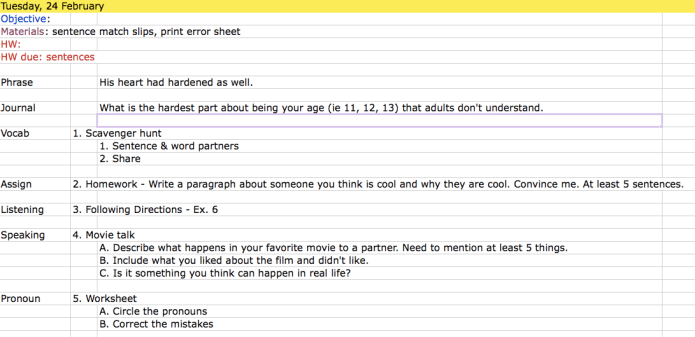
Visual of a lesson plan

The rabbits hopped all night long

Some people were wondering how I make my magic:

First off, organizing this thing called teaching, would be a heck of a lot more difficult without my wonderful teachers from the Concordia University TESL/TEFL Certificate Program. Those women are idea masters, and while I’m sure they’d look at my lesson plans and find tons of areas for improvement, including my inability to set concrete objectives, I know I’d be doing worse without having basked in their wisdom for three weeks last summer.

I have an English curriculum but my kids are so behind that I’ve barely looked at it. We started the year by reviewing the present simple (Rabbits hop. Do you hop? They do not hop.), present continuous (Those damn rabbits are hopping!), past simple (The rabbits hopped all night long.), and the past continuous (While the rabbits were hopping, the students failed to understand this tense.). That carried us through the first two parcials. Now in the fourth parcial, we’re slogging through comparisons, including similes (She is as ugly as a monkey. My feet are smellier than your feet. They are the smelliest in the world!). Along the way we’ve started and quit Holes by Louis Sachar, a wonderful book but too difficult for my little bilingualites, studied parts of speech, basic sentence structure, the paragraph burger, spent an entire term on pronouns, and are about to explore the future simple and “going to.” We will probably wrap up the year with a review of prepositions. If this were third grade, I’d feel rather accomplished!

I’ve seen others’ lesson plans and can only drool at their simplicity—“Grammar tense,” “Do stuff,” “The End.” My memory is crap, as are my improvisation skills, which years of theatre games only reinforced. My lesson plans are detailed and color coded and written in Excel so I can have everything aligned and indented just right.

I plan my week around a short list of goals, usually a grammar tense, to be practiced in reading, writing, speaking, and listening (RWSL), and a specific writing skill, like paragraphs, and build my lessons from there. Starting with the third parcial, each day of the week has a certain task or skill area we always do. For example, we start every class with a Phrase of the Day to work on pronunciation and do an activity with that week’s vocabulary. Mondays always introduce new vocabulary; Tuesdays and Thursdays include reading a short story; Wednesday, a listening activity and review of troublesome sentences from the vocabulary homework; Thursdays, Bingo; and Friday, vocabulary quiz. Well, those are the goals, anyway. Inevitably, the activities take longer than anticipated and things get shuffled around, but the outline of the ideal week saves me so many hours of wracking my brain for a variety of activities that work on all the skill areas. The first two parcials found me floundering in a sea of how to fill my all of those minutes. Now, I still flounder, but less.

As for the day to day…here’s what it looks like:

Phrase of the Day: I found a TEFL site with silly limericks. We practice a line a day and then put it together at the end of the week. Pronunciation is tricky to practice because the kids feel self-concious about speaking alone, and I can’t correct them too many times or they retreat.

Vocabulary: There are only so many activities I can do. Some activities found online look fun, but I can’t imagine my kids understanding them or cooperating, or having the resources for them. But we have a staple, including the race-to-the-wall-to-find-the-paper-with-the-correct-word-once-Miss-T-has-read-the-definition-but-do-not-attack-your-competitor game.

Grammar: Look on the internet for exciting, limited resource, kid-appropriate activities, that will also accommodate their miniature attention span. Eliminate the numerous websites that promise “exciting worksheets,” an oxymoron if ever there were one. Consider low-tech alternatives to high-tech ideas. Consider prep time. Superlatives lead to a boon of activities the kids liked, including “Best of the Class.” The kids voted that Joe is the most handsome and romantic and that Kim and Jojo are the silliest. Krissy, by a landslide, is the strongest. An ideal activity can be exploited to cover more than one skill. Writing—students had to make a correct superlative sentence for their vote to count; speaking—students had to discuss with a partner if they agreed or disagreed with the results (not that the students ever talk in English unless I’m hovering over them); writing/paragraphs—students had to write about one of the results and why they agreed or disagreed with it. Later I might copy out some of the paragraphs and use this as a How to Improve Your Paragraph study.

If I can’t find useful ideas online or in my Azar grammar book, especially for speaking, I attempt to create my own, with varying success but almost always with slips of paper with drawings or words on them that the students have to pull from a pile to utilize in some way. Some work in reality, others, only in my mental classroom. As for worksheets, the few times I’ve downloaded them from websites, they’ve been for too difficult for the students, or just really bad, so I write my own, an exercise in tedium.

Tap dancing: In general, this is how I feel as a teacher, that I have to entertain my kids every moment. Be the most interesting thing in the room, make learning inspiring and dynamic, blah blah, all the responsibility is on me. I completely agree that a teacher should try to make lessons as interesting as possible, but the kids take this one step further and expect playtime. Sometimes I get that old fart feeling akin to the “When I was a kid we walked up hill both ways to school.” Boring or not, I/we did our work. I don’t remember my classes being activity filled. I don’t remember working for parties or behavior points. Yet, that’s what I’m expected (by the kids) to do, and if I don’t, all I hear are whines of “This is so boring” or “You never let us play football.” They’re kids, I get it. I take this all too far too heart. I’m not meant to teach kids at this level. What would it be like to teach people who wanted to be there? The occasional moment I hit on something they like is such sweet relief, this happiness, that learning or no learning, I want the moment to continue. I make note of the wins and failures and hope for the best.

As the end of the year nears, it’s tempting to just phone in the lessons, give them free periods, try to avoid bumps. But, like I tell the kids, I’m mean. Yes, it’s 100F outside and in, and I still expect them to know the difference between a noun and a verb. I refuse to be sorry. (Okay, I wish I were that firm…but I’m just so tired.)

Back to the whiteboard,

theresa

My gross keyboard

The Machine

I don’t know where this came from but it interests me more than the other entry I’m working on and might be more honest:

It wasn’t always like this. My days stretched between pre-dawn to post-sunset darkness, and in the light, I carefully, slowly turned the pages. Then, when the time came, I swung my arm to the chain above my head, pulled, and was clicked back into the dark.

Now, I almost never finish a book. I walk the aisles of the library, salivating over titles, book covers, and synopses. I gather a stack of the promises of escape and slide them across the scanner into my bag, which I struggle to clip shut, and pedal home with the promises digging into my back. Sweaty, home, books stacked against the false living room/kitchen/eating area divider, I stare at the titles from the reading chair, and choose that with the greatest promise of erasing the divider and cement floor and tomorrow’s 5am alarm and cold shower. But the words are crap. The words are obviously someone else’s, that person wants to manipulate me, and after a sentence or few pages my eyes slip, the book slips to the floor. Then I reach across for the next. Until everything is on the floor.

My mother died last year, and before you say this inability to read is some fallout from that, let me tell you that I didn’t love her, that she was a woman not to be loved, that her embraces were cold and she left the hearts of men and women behind her, and mine.

Do you love your mother? Do you ask yourself why? Why are we shocked at the lack of love but not its presence? If you tell me you didn’t love your mother or your father, I promise I won’t treat you any differently. I won’t offer sympathy or sad eyes or a pat on the back. Instead, if you brought this up while we were discussing dinner, I will find this a curious segue and return to the original topic. If you insist on returning to your segue, I will order pizza and then sit with you to discuss what you have chosen as our follow up issue.

Some coworkers call me The Machine. The truth is that we place far too much value on hormonal fluctuations that cause someone to love one day and hate the next. Why is this useful? Instead our efforts should be on monitoring and controlling our responses to red, blue, and the numbing effects of beige. That I didn’t love my mother is irrelevant. Did it cross your mind that she might not have loved me?

This recent stack is the most useless. I’ve held the books but can’t open the cover. The idea of attempting escape seems useless. Time is neutral. It moves. Tomorrow always comes.

I am the first, I arrive before my fellow clickers and our overseers, and I flip down the toilet seat in the last stall and perform the day’s first flush. I secretly fear (fantasize?) that one day I will find a dead body sitting on the toilet in this last stall. A coworker or one of the cleaners, perhaps a client. Again, hormones, but I can’t deny them.

My place is in The Room, the largest space in the office filled with long brown tables, narrow, crowded on each long side with computers. At the end of each row is a box of white or black mice, new and shiny or repaired and greasy. I sit in the corner farthest from the door. This is the corner with the window, the size and height of a bathroom window, but it’s a window. It lets in no light or air and its purpose is unclear for that reason, but it does let in faint birdsong. City Park is across the street from our building. City Park has trees and grass. The grass is covered in birdshit because this is the only place in the city with trees. Some days it is hard to breathe, and I walk to the park, cover my feet with plastic bags, slip on a poncho, and wade in. I place another plastic bag on a bench and sit. Imagine the smell. Imagine the cool oxygen.

In the dark of The Room, the monitor glows to life, my left hand moves from my lap to its far too familiar position around the mouse, and I start clicking. An hour passes and The Room is hazy with a hundred forefingers clicking the required minimum of five times a second. Light on blank faces flicker. The Oxymachine rattles off and on. A mouse is ripped out and dropped to the floor, “Replace!” yelped, and a replacement passed hand to hand until it is attached and clicked. This takes time and the forethinkers keep the day’s replacement in their laps. Click click click trill woot trill woot click click click trill trill trill comes in. Sometimes the song’s rhythm slips into my forefinger.

At eight hours, the screen darkens, my total clicks of the day flashes in neon-green, along with my day’s wage, at 2 cents per click. The overseer stamps me out and I collect my paycheck from the machine outside. The few friends I have envy this daily payment, but it’s only a reminder of my expendibility.

a horse eating snacks

Snacks and teachers’ meetings

In my previous life as a paralegal, I arrived at work by 730am, but rarely took my lunch before 2pm. This way, once lunch was done, I had less than two hours left in my workday. That half hour lunch was my oasis of relief, and the promise of less than two hours more of work served as my proverbial carrot (cake). Not very healthy.

Today, during our unending teachers’ meeting, a volunteer commented that she’d rather our communal breakfast were skipped or eaten while the meeting carried on, in favor of it ending earlier. This struck me as very U.S. American, with our business lunches and working breakfasts and networking happy hours. Let’s dilute a pleasurable activity by combining it with an unpleasurable one. Let’s squeeze more work in.

During his visit, my partner in crime, a.k.a. Jason, marveled at the Honduran love for snacks. Over the course of a three hour ride from Santa Rosa to Las Ruinas, our rapidito stopped to be boarded by snack vendors about five times. The vendors swarmed aboard or approached the windows and shook baggies of candied popcorn, mango slices, coconut water, sodas, and other unidentifiable-to-gringos juices and fruits, Despite the previous snack stop having been only an hour, half hour, or, in one case, five minutes, earlier, the vendors always found buyers. Meanwhile, Jason and I desired only that the rapidito reach the endpoint as quickly as possible.

Bus rides are boring and often uncomfortable if they’re at the full-to-bursting stage. Perhaps that’s why the vendors are so popular—a spot of pleasure. Teachers’ meetings are boring. But breakfast? A break in the monotony. In both cases, the totality of the event is extended, but there is a little good mixed in. Without the snacks or breakfast? It’s all just a slog.

A few years ago I read an anecdote about a road trip taken from one state to another. The original plan had been to drive straight through but somehow—a more spirited companion?—they’d gone the long way, through landmarks and sights, and the trip was longer but much more enjoyable than planned. The point was that the pleasure of the journey counts just as much, if not more, than how fast you get from here to whatever there you’re seeking. The how matters as much as the why and what. I think about this story often, in a literal sense, when I’m impatient to get to a location and a less than expedient route is taken, and in a figurative sense, as I take my winding route to what ever professional end I decide on. Here, asking a neighbor to borrow a chair begins with discussion of the day and weather and family, and eventually the favor is requested. Pleasure in the process.

My appreciation for the journey doesn’t extend so far as 8am teachers’ meetings, however. Today, the Honduran staff chattered and joked and teased each other for half an hour about the activities they would assemble for Dia del Idioma. A day that only they, and not the volunteers, are involved in. Meanwhile, the rest of us doodled. Nearly all discussions devolve like this, into bromas and chistes and unrelated segues, and the meeting is twice as long as it needs to be. Sure, there are volunteer-only lead events, but we discuss those at our own weekly meeting, which is much more focused but probably a lot less fun. Which is better? If we all enjoyed the diversions, if we were all friends, I’d wholeheartedly support the Honduran approach, but in this reality, my crank-o-meter rises the longer the laughter goes on. After all, the volunteers didn’t take up the meeting discussing what they would each make for International Day, as the Honduran staff did.

As I looked on from my side of the room, and, I swear, from a completely uncomfortable plastic chair and not from some perch of superiority and disgust, which seems to be the tone here, I caught a whiff of my classroom environment. The students understand lecture and note taking (not fun) and playtime (whoa! extreme chaotic fun), but not the grayer points between the poles, like discussion and structured hands-on learning, which often explode into chaotic play. It would be too strong to say that our teachers’ meetings are this way, but the reflection does pass through gently rocking waters. It’s obvious that so many of my challenges are cultural. The division between work and play is blurry. Part of the meeting was spent reminding the (Honduran) teachers not to play on their cell phones during classes. For the past several meetings, a reminder has been issued to the (Honduran) teachers that detention is not a time to chat and gossip with the students, which is why the volunteer teachers give out only lunch detention, which we supervise. Also, BTW, for the third time, detention has been moved out of the library and into a classroom, because the library is too small. And please make sure your kids clean up whatever mess they make during your art class, before the bell rings. And please stop letting the big kids out early for lunch because they trample the little kids. And Miss X, no wonder your son talks through my class because you have just talked through this entire meeting. The administration admits that they don’t separate personal and professional, so constructive criticism is a tripwire.

I can’t deny that during meetings like this, the thoughts cross my mind, No wonder the students act as they do. No wonder the country is so chaotic and behind. Act like grownups and get shit done! Ugh, knee-jerk moments of cultural snobbery. Or is it? Yes, it is, mostly. The Honduran culture seems very warm and social, where as the U.S. American is colder, more robotic. In the U.S., the project is more likely to be done by the deadline, but, in the meantime, I have no idea who I’m working with and didn’t have much fun. Here, the project will, inevitably, be late, but I’ll have made new friends who insist on bringing me treats when I’m sick (Vee recently had chikungunya). Both approaches have their advantages. Being socially awkward, I prefer the former, while feeling its hollowness. I’ve always struggled to balance pleasure with work, my scales tending to lean toward the latter, despite the river of silliness running through me. No doubt this is why I’ve chosen a partner whose scales favor the opposite.

This post is finished on Sunday, 12 April (posted two days later due to internet problems). I have exactly two more months of work here. While we don’t know (still!) the last day of school, the administration has told the extranjeros that 12 June is the latest date we’re expected to stay. My cool science fair idea is not possible due to a lack of rubbing alcohol, but my idea for Parents’ Day—have the seventh graders swarm the parents with handmade flowers—was received excitedly. I still don’t know what to make for International Day, but am leaning toward peanut butter refrigerator cookies. Also, horses are fans of snacks.

Moving along, slowly, steadily, sweatily, but never, ever suavely or smoothly,

theresa

view from finca

The final push

Here it is: the final push toward the end. Spring break (Copán with the partner in crime, wonderful, beautiful, comforting, heartbreaking, all the expected superlatives) ends tonight and only (or “only”) eight weeks of teaching remain. I remember early September and questioning survival until the five day weekend at the end of October. That weekend is long gone—but so easy to recall—and now I cling to the promise of permanent relief from this…this…grand experience.

The activities calendar for these last weeks is a procrastinator’s delight of events that could have been spread more evenly over this year but instead have been saved up until we are all exhausted and sick of this. Okay, maybe that’s just me. Science Fair (Come up with an entertaining science project with limited resources!), Parents’ Day (Make your kids do something adorable!), International Day (Make food from your country! Sell it! Maybe you’ll earn back the money you spent!), and Academic Olympics (Make up a game that tests smarts!). Too many of these boil down to This [vague idea] sounds really fun. You [teacher] come up with something educational that everyone will enjoy and make money for the school.

So much freedom and pressure does not summon creativity. Rather it unleashes the demons of self-doubt and anxiety and frustration and resentment. This is why I will never teach again at a general school such as this, where I know this insistence on extracurriculars is the norm. It’s these things that feed the growing monster that hisses I’m paying to teach at the school. I’m paying for this stress, and now you want me to spend more of my money—regardless of little it will be in actuality—and more of my time to make fun for the kids (overlooking that I do all in my power to make learning fun everyday)? Welcome to volunteering.

I don’t think like this most of the time. Only when I’m pushed. My inverse is quite ugly. It doesn’t help that most of the other volunteers, on the surface anyway, are unflustered. It’s only Vee and me, and maybe the sixth grade teacher, we who struggle with the hormone-throbbing whiny rebels, whose shoulders sag in anticipation of these events. But the distance to the end, rather than from the beginning, is now countable in weeks.

In addition to the weekly count, I’m starting the retrospective. I wonder who will remember me. I remember many of my teachers, and several, particularly those from middle school, are gone from my memory. I don’t expect to remembered by all—I don’t care about that—I want to be remembered by the students I work for, the ones who want to learn or who are at least diligent or with whom I’ve forged a connection…like Joe and Krissy and Isabel and one of my geeky boys and a few of the ninth graders, who rarely find themselves on this blog. The ones for whom I fight, despite my inadequacy. Volunteering may seem a selfless act, but my ego cries for recognition of the sweat and wrinkles, and the everything I’ve given here. Some will, I know. The dear ones…?

And who will I remember?

I’m questioning how I’ve changed. I have, but will save those observations for the end.

I don’t, and imagine I won’t, question if this has been worth it.

An abrupt ending, but I want to spend these last hours in a book or watching a series that I discovered a few days ago. Then it’s once more unto the breach, dear readers. (Well, if I can find it.)

In survival,

theresa

P.S. Photo from Finca El Cisne, a place you must visit if ever in Copán Ruinas.

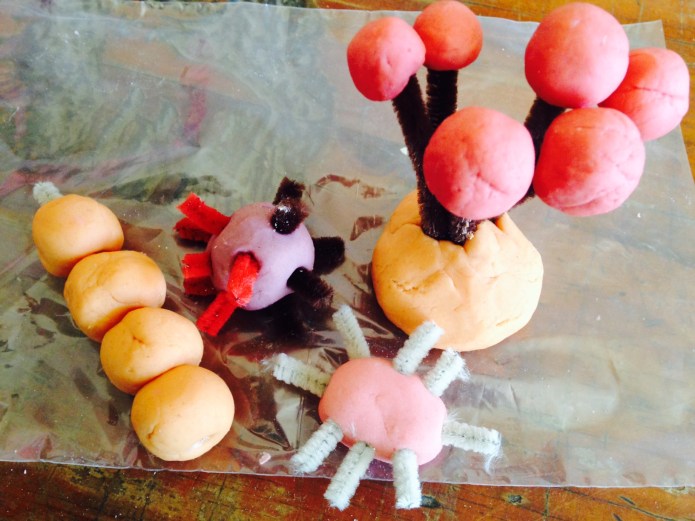
Bacteria and virus models

Sweetheart and the enigmas

Admire this week’s science project above—making bacteria, viruses, protozoa, and fungi with clay and pipe cleaners—and meet Isabel, John, and Tara.

Isabel

When I consider my failings as a teacher, I think of her. I suspect Isabel’s often bored and frustrated with the classroom disruptions and slower pace of her classmates.  Diligent, she’s the most reliable when it comes to studying. When I asked the students to write a short story, 10 sentences, about their lives at Camp Green Lake, the setting of Holes, she developed an adorable piece about becoming best friends with a “gentle” (vocabulary word) boy there, who later became her boyfriend. When I suggested that she consider writing as a career (I can dream), she laughed. Like Joe’s, her imagination is colorful and my envy. She’s one of two who puts effort into their bi-weekly journal entries.

Isabel is still a pre-teen however, with moments of slack. Friday she said she couldn’t finish her paragraph about being sleepy because she was too sleepy. (I recommended she write, “I’m so sleepy that I can’t even finish this paragraph.”)  Likely because of the language difficulties, or because I inspire revelation, she can be rather frank, openly admitting she didn’t study for the writing exam because she was busy with another teacher’s (English always takes a back seat, despite this being a bilingual school.). She makes such observations with her sweet laugh. Sometimes she’ll stand near me, perhaps with nothing much to say, and I’ll wrack my brain for conversation. She confides in me that another teacher’s classes are boring and also when mine are boring; yet, despite her boredom, she has on occasion told me how happy she is that it is my class. Perhaps I am not boring. When I have doubts about my effectiveness as a teacher, I look in Isabel’s notebook and see improvement. I see and hear her try. These signs reassure, a comment, I suppose, that contradicts my “failings” comment above, but let that stand. Isabel can move at a much more rapid pace, but I’m not equipped to manage different levels.

As with nearly all of the kids, Isabel is obsessed with love, as well as Logan Henderson of One Direction, Facebook, my comparatively newer iPhone, and discovering the password to my computer. She has an older iPhone and braces. In fact, she’s one of few students with braces at school, which gives you an idea of her family’s financial situation. Petite, with a sweet smile, she is among the most fashionable on Color Day, in dresses too old for her, but elegant nonetheless. I’ve never had such style.

Isabel is the only one who unfailingly thanks me when I hand out anything to the students. She is a sweetheart.

John

The enigma, a student whose mind I have been unable to open for a peek. He will not speak unless called on, and then in a mumble, and is quick to join the other three boys in goofing off in class. Despite this, he vies with Isabel for the top spot. I often wonder if he is uncomfortable being (one of) the best in the class, among the boys, and this is why he goofs off so wholeheartedly, to fit in. Or, more likely, he’s just a short, stocky boy, who doesn’t make the 8th grade girls’ A-list, who’d rather play than work.

Because he confuses me, I am nervous and awkward with him, afraid that he senses my confusion—did he just glare at me? am I seeing contempt? So I consciously praise him and touch his shoulder during corrections. John usually puts in the minimum effort in class and is just as untrustworthy as the other boys for working independently. This adds to my confusion…and distaste. But—of course, but—he surprises. Parcial exams ended this week. His paragraph, a response to the question Are boys or girls smarter? thoughtful, mature. He said both were equally smart…because both are human and have the same potential. This is not the prevailing cultural thought and most students were decidedly in one camp or the other. I was surprised and softened.

Insight alert: I cannot find a vulnerability or place for connection with John. Were I replaced tomorrow, I suspect he wouldn’t care, and this summons insecurity, because if I am not needed (wanted?), in some way, why am I here? Isabel may not be insecure, but she needs me and my teaching. Antonio may be frustrated with me more often than not, but I know he is appreciative when I explain and he understands. Joe lacks confidence, but I am confident, more or less, in my ability to evoke the bright flashes I see in him. Moments like these answer the question, “Am I needed?” With John, I have none of these. I can’t tell if he’s a good, quiet kid or an asshole, a theory I developed after some exchange I don’t recall well.

But, no, I must remove that asshole consideration after his response to the writing exam question. There is someone thoughtful and considerate in there. I just might never get to meet him.

Tara

Oh, Tara, where to begin? At the beginning of the year, Tara was Kim’s coloring cohort. Now she more often colors alone. She’ll request permission to wash her hands because the pen she was chewing on or the marker she was toying with burst. Five seconds after I’ve given instructions, she’ll ask, “What, Miss?” or “For the notebook, Miss?” having returned from her cloud. If I take a breath, she’ll burst in with a non-sequetorial “How many homeworks [until I get a prize]?” no matter how many times I’ve stated she can ask at break. As the year progresses, I’ve (shamefully) grown increasingly sarcastic in my responses, having no idea how to address her delay, the inattention. Attempts at personal talks, to solicit questions or request behavioral changes, are met with an uncomfortable eyes-averted, “Nothing, Miss,” or “Yes, Miss,” implying she has no questions or understands, when she obviously just wants the conversation to end. Corrections are met with denial and cease communications notice. Like John, I haven’t found the way in.

Her work is erratic, but quiz scores are high, indicating that she studies, and even remembers. After a student tipoff that Tara had cheated on a quiz, I questioned her a few days later. No cheating; she knew her stuff. She is eager to participate in board work—but on her terms. If she doesn’t get to go first, forget it—bingo, and most games. In her own mind, she is infallible. Actually, that could apply to most of the students. They are all perfect, in their own and God’s eyes.

Like John, she is an enigma, but of a different type. A less kind person would suggest that she has a screw loose. Let’s just say she and I have different priorities…and maybe different planets.

And now it’s Semana Santa!

theresa

A plant with sports

You so crazy

Nothing gets me talking better than the topic of my students, and since I described a few of them last week, here are a few more, all seventh graders. Although I teach three grades, I teach these crazy guys at least three classes a day and think about them the most.

Antonio

During one of our parent-teacher-student behavior meetings, I asked Antonio to be my superhero, like Iron Man, and use his power for good. Tall, attractive, engaged in an active love affair with hair gel, and cocky, Antonio is the obvious leader of the class. He doesn’t walk across the school yard, he struts. During a game of grammar tic-tac-toe, his teammates sought his approval prior to placing their mark on the board. Jojo refused to compete against him in a review quiz game. When the first grade English teacher substitute taught my class this week, due to some scheduling craziness, and she was glaring at him for silence, he commented that she must be looking at him because he was so good-looking. He is confident in his immortality.

Of all the kids, it’s most difficult for me to remember that Antonio is still a child, because he’s tall, because his spoken English is fluent, because his defiance is strong, and I, a neophyte, easily fall prey to his manipulation. I roar internally in frustration at his academic scores because he’s smart but thinks he knows everything and always races to finish his work as quickly as he can, then bother those who aren’t finished. He could do much better, but he’d rather comb his hair and chatter. He laughs loudly when others make mistakes, which further discourages students from risking themselves.  He’s also a baby and, I suspect, babied by his mother. Whenever Antonio is chastised more than he thinks he deserves, he puts his head down and refuses to talk. If given detention, he pouts and threatens, “I will not come.” When asked to write about an awesome person, Antonio wrote about his mother, whose awesomeness stems from her giving him whatever he wants.

Yes, he’s a kid, a popular kid. I struggle to like him. He probably taps into the wounds I retain from my own middle school years. He can be charming, but it’s a power struggle, always, and I often hear his protesting voice in my head. When I can find a moment of vulnerability, like when I catch him needing help with something, I spread my teacher-gifted-with-knowledge wings and flash them in an attempt to blind him into humility. Despite how middle school theresa may feel, Teacher theresa does care. He’d make a good politician. I just want him to be an intelligent and kind politician.

May

There are students closer to my heart than others, and May is one of them, mostly due to the near deadpan inflection of her English, which renders her work protests hilarious. She shakes her head and tells me, “Miss, I don’t understand,” with a strange little lift at the end and a flat-lipped, embarrassed smile in her half-turned face as if this is a strange thing I have caused, this not understanding, and she’s casting it off to me to do something with that information. It stems from insecurity and a self-rooted assumption that she will not understand whatever I’m teaching. I’m not sure why she feels this way, and it may be my fault. Despite months of being with this crew, I still am unable to gauge the difficulty of my lessons. So before quizzes and exams, when I remember—increasingly difficult with my sieve of a memory—we review during lunch time and she passes, whatever the topic, or she doesn’t. She works hard, I think. May is a Good Student, not great, but good. I don’t often enough see her smile and I will tease her and turn myself on my head, in our free moments, to find it in her sweet face, that wrinkled-up nose, averting her eyes. I often want her approval and wish I knew her better.

She loves to make cakes…if only I could get her to make one for me.

Krissy

I am the only volunteer teacher who is fond of her. Big, loud, and a school hater, Krissy is a bully. She frequently and at high volume disrespects her teachers and kicks or punches other students. Hers is another voice I hear in the quiet and it often says, “Miss, but I no want to!” Another volunteer proclaimed that Krissy is “just too much.” I suspect I love her for a vulnerability that is rarely revealed.

Early in the year when I’d allow the students to find relief from our stifling and loud classroom by working outside, Krissy’d wander away and bother other classrooms. I confronted her and explained that because of this tendency I couldn’t trust her, despite wanting to. I’m not sure why, maybe it was my speaking to her seriously and honestly, but our relationship after that changed. She started trying more and looking my approval. If I gave her The Look, she’d stop talking, for at least a second, and work. She’d argue less. And we built this relationship where if Krissy gives me crap, I can give her crap right back:

K: Miss, it is so hot and boring.
T: I know, Krissy, but you are young and strong and in my heart of hearts I believe you will survive. Can you? Can you make it through this rough day?
K. (Smiling) Oh, Miss, you so crazy.

And she’ll try…for a minute.

Krissy is the biggest—okay, fattest—kid in school. At a parent-teacher meeting, her aunt mentioned that the family couldn’t get her to stop continuously eating. Her aunt suspected stress from school. When we were studying earthquakes in Science, an eighth grader joked it was Krissy walking. During a writing exercise where kids had to write a sentence then fold over the paper and pass it to another student to write the next sentence, someone compared Krissy to an elephant. And Krissy, big, strong bully Krissy, who never shows hurt from these comments, was upset. My middle school self, one that was also relentlessly teased, the memory of which struggles against Antonio, hugged her. My teacher self struggled to find a solution and felt inadequate.

Krissy’s family is a good one. Her mother is a dentist, her father a mechanic. Both care for their daughter, though seem confused at times by her behavior. Krissy now sees a psychologist, though I’m curious if she actually talks to him/her, because it’s difficult to get beyond the superficial. Krissy excels in math but hates Science and English. (This post’s picture is what I drew on a quiz when she wrote that a plant could reproduce with sports, not spores.) She has great listening skills and is fluent, if grammatically atrocious, and her writing and reading skills are weak. Recently I started tutoring her once a week, and while she’ll lie slickly to wiggle out of it, to the point that I call her mom if Krissy tells me tutoring has been cancelled, our sessions are fun and she’ll play along. I suspect she enjoys the attention. I enjoy shocking her, such as by telling her I used to dye my hair all sorts of colors. I love her incredulous smile and her look of surprise when she gets something right.

If the other volunteers spent as much time with Krissy, I wonder if they’d change their minds about her. They see her picking on their little kids and protesting their instructions at top volume. I see these things too and daily get on her case for physically responding to a slight. But I also see how she is picked on by others for her size and poor vocabulary, and while I don’t see it, because it’s hidden, I know this hurts her. And, I suppose, I like her because she likes me and I’ve figured out, a little bit anyway, how to work with this girl who’d much rather be at home watching Calle 7.

And those are three of my kids.

ta ta,

theresa